
There is no single product called “the SABRE gun.” When people search that phrase, they usually mean one of three things: the SABRE 0.68-caliber pepper projectile launcher, the SABRE Aim & Fire pepper gel gun, or a SABRE stun gun with flashlight.
All three are less-lethal personal safety devices built by Security Equipment Corporation, the company behind the SABRE brand. All three are designed to create time and distance for escape. None of them guarantees incapacitation, and none functions as a firearm.
This guide breaks down each product category, explains what it can and cannot do, and helps you determine which one fits your situation. If any of them fit it at all.
One important distinction before we go further: “non-lethal” is a popular search term, but “less-lethal” is the more accurate label. Pepper projectiles, electrical devices, and kinetic impacts can all cause serious injury under specific circumstances. SABRE’s own documentation acknowledges this.
Looking for a PSA Sabre firearm? Palmetto State Armory produces a separate Sabre line of rifles and handguns. Those firearms are unrelated to the SABRE personal-safety products covered here.
SABRE Gun Comparison: Three Options at a Glance
Before getting into the details of each product, here is what separates them at the highest level.
| Feature | Pepper Projectile Launcher | Aim & Fire Pepper Gel Gun | SABRE Stun Gun |
|---|---|---|---|
| Deployment type | 0.68-caliber projectile | Directed gel stream | Direct electrical contact |
| Working distance | Up to 60 feet (direct impact) | Up to 15 feet | Contact only |
| Capacity | 7 projectiles per magazine | 10+ seconds total spray time | Battery dependent |
| Power source | 12-gram CO₂ cartridge | Replaceable gel canister | Rechargeable battery |
| Primary effect | Impact plus pepper powder | Pepper gel irritation | Pain from electrical charge |
| Indoor concerns | Pepper-powder contamination | Reduced airborne contamination | No chemical contamination |
| Portability | Full-sized | Moderately portable | Compact |
| Training option | Inert practice projectiles | Practice canister included | Dry handling and function testing |
| Best general role | Home defense with distance | Portable directed pepper defense | Close-range backup |
Quick recommendation:
- Choose the launcher when maximum stand-off distance and home-defense capability are your priorities.
- Choose the Aim & Fire when portability, simplicity, and reduced airborne contamination matter most.
- Choose a stun gun when compactness and flashlight utility matter, but understand it requires physical contact with the attacker.
SABRE Pepper Ball Gun: The 0.68-Caliber Projectile Launcher
The terms “SABRE pepper ball gun” and “SABRE projectile launcher” refer to the same device. SABRE officially calls it a pepper projectile launcher. PepperBall is a separate brand with its own products, though the names get used interchangeably in casual conversation.
What Is the SABRE 0.68-Caliber Pepper Projectile Launcher?
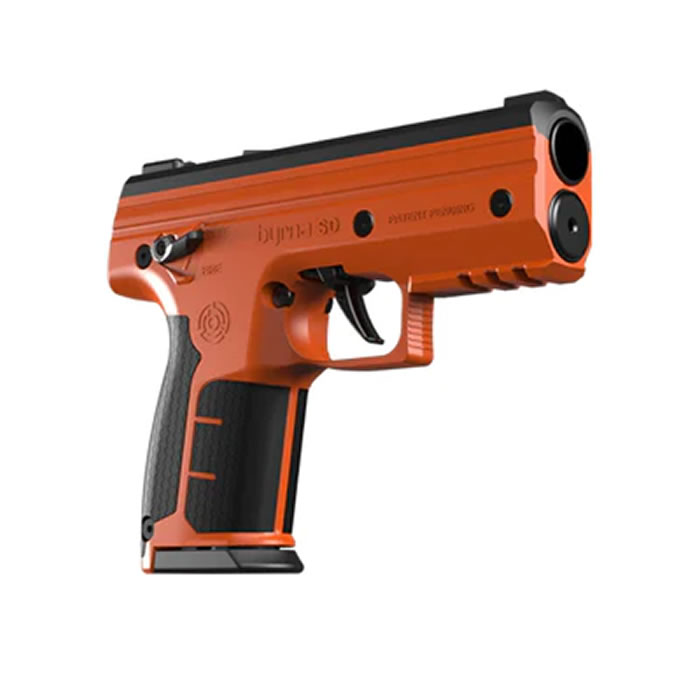
The SABRE SL-P1C is a CO₂-powered launcher that fires 0.68-caliber projectiles from a seven-round removable magazine. It uses a 12-gram CO₂ cartridge for propulsion, generates minimal conventional recoil, and includes adjustable fiber-optic sights and an accessory rail for mounting a flashlight or laser.
The launcher features a grip safety, a projectile viewport on the magazine, and a magazine release. It is designed primarily for home defense.
SABRE currently claims direct-impact effectiveness up to 60 feet, velocity up to 350 FPS, and indirect pepper-cloud deployment against hard surfaces up to 175 feet.
How Does the SABRE Pepper Launcher Work?
The deployment sequence is simple in concept but has one critical readiness step.
- Load the magazine with approved SABRE 0.68-caliber projectiles
- Install a 12-gram CO₂ cartridge
- Leave the cartridge unpunctured during storage
- Puncture the cartridge when deployment becomes necessary
- Deactivate the grip safety
- Aim and fire
- Escape and contact emergency services
That puncture step matters. SABRE recommends storing the launcher with projectiles loaded but the CO₂ cartridge unpunctured. This preserves gas pressure during storage but adds a manual step before the first shot can be fired. If you have never practiced that activation under stress, it could cost seconds you do not have.
Direct Impact Versus Indirect Pepper Deployment
This distinction gets blurred in marketing, so it needs a clear explanation.
Direct impact (up to 60 feet): A projectile strikes the target, combining kinetic pain with pepper-powder release when the shell ruptures on contact. This is the scenario most buyers are imagining.
Indirect deployment (up to 175 feet): A projectile is fired against a nearby hard surface. When it breaks, it disperses pepper powder into the surrounding area, creating an approximately six-foot cloud. The 175-foot figure represents how far a projectile may still travel and rupture against a hard object. It does not mean 175 feet of precision. It does not mean reliable incapacitation at that distance. For practical purposes, the 60-foot direct-impact range is the number that matters.
How Powerful Is the SABRE Launcher?
SABRE advertises up to 350 FPS. Velocity alone does not tell you how hard something hits. Kinetic energy is what determines impact force, and that depends on both velocity and projectile mass.
SABRE lists its pepper projectiles at approximately 3.2 to 3.4 grams. Using those figures at the maximum advertised velocity produces a theoretical muzzle energy of roughly 18 to 19 joules. That is an estimate based entirely on manufacturer numbers, not an independent chronograph test. Actual energy drops with distance.
It is also worth separating the two parts of the deterrent. The kinetic hit causes pain. The pepper powder causes irritation to the eyes, nose, and respiratory system. Those are independent effects, and either one can fail on its own. A projectile that misses delivers no kinetic energy. A projectile that does not rupture releases no pepper powder. A direct hit may deliver both, but even combined, neither effect guarantees that an attacker stops.
What Does “40% More Stopping Power” Mean?
SABRE repeatedly advertises “up to 40% more stopping power.” The article would be incomplete without asking: compared with what?
- Which competing launcher forms the baseline?
- Is the comparison measuring velocity, kinetic energy, projectile mass, or something else?
- Does it apply to the pepper projectile or the impact projectile?
- Has SABRE published the testing methodology?
Without a reproducible comparison standard, this remains a manufacturer marketing claim rather than a demonstrated and independently verified performance advantage.
Pepper, Impact, and Inert Projectile Options
Pepper projectiles combine a frangible shell with pepper powder. On a direct hit, the shell ruptures and releases the irritant while delivering kinetic impact.
Impact projectiles are sold as a separate package (SL-P1C-2) and deliver kinetic force without a chemical payload. These exist partly because some jurisdictions restrict pepper projectiles but allow kinetic-only launchers. SABRE lists impact projectiles at up to 330 FPS, slightly lower than the pepper version.
Inert practice projectiles are included in the kit. They exist for a reason. Every owner should use them for sight alignment, trigger familiarity, CO₂ activation practice, magazine changes, and target practice before ever relying on the launcher in an emergency.
Can You Use Steel Balls or Third-Party Projectiles?
No. SABRE instructs owners to use only approved SABRE 0.68-caliber ammunition. The manufacturer warns that unauthorized projectiles can cause malfunctions, serious injuries, and warranty loss.
Some online discussions recommend loading steel balls, metal-core rounds, or improvised projectiles. This article will not echo that advice. Modifying a launcher designed for frangible pepper projectiles introduces failure modes the manufacturer has explicitly warned against.
Can You Keep the SABRE Launcher Loaded?
This is one of the most commonly searched questions about the product, and the answer is a qualified yes.
- The magazine can be stored with projectiles loaded
- The CO₂ cartridge should remain unpunctured until needed
- Once punctured, the cartridge begins losing pressure over time
- A fresh cartridge should be installed after any use
- The activation step must be practiced repeatedly
- Loaded storage must prevent access by children and unauthorized users
SABRE claims approximately 14 shots from one CO₂ cartridge under suitable conditions. Temperature and rapid-fire sequences both affect that number.
Launcher Strengths and Weaknesses
Strengths:
- Greatest stand-off distance of the three SABRE categories (up to 60 feet)
- Seven rapid follow-up shots
- Combined kinetic and irritant effects
- Adjustable fiber-optic sights and accessory rail
- Training projectiles included
- Often less expensive than competing launcher systems like Byrna
- Available in pepper and impact configurations
Weaknesses:
- CO₂ activation adds a step before the first shot
- Temperature-sensitive gas performance
- Velocity drops during rapid shooting
- Full-sized design is difficult to conceal
- Indoor pepper contamination affects everyone in the space
- Seven-round magazine capacity is finite
- Projectiles can miss or fail to rupture
- Resembles a handgun, which creates misidentification risk
- Legal restrictions vary significantly by state and locality
Is the SABRE Launcher Good for Home Defense?
It can be. The launcher makes the most sense when there is enough distance between you and a threat to use its range advantage. Hallways, larger rooms, exterior approaches, detached structures, and safe-room defense all fit the design’s strengths.
It makes less sense in extremely confined rooms, contact-distance encounters, homes where vulnerable occupants (children, elderly family, pets) would be affected by airborne pepper powder, or situations involving an armed attacker where the response time gap created by CO₂ activation could be dangerous.
The launcher is a tool, not a guarantee. Treat it as one layer in a broader security plan that includes locks, lighting, alarms, communication, and a rehearsed escape route.
SABRE Pepper Spray Gun: The Aim & Fire Pepper Gel Gun
“SABRE pepper spray gun” is the high-volume search term, but the product actually deploys pepper gel, not aerosolized spray. That difference matters and works in the buyer’s favor.
What Is the SABRE Aim & Fire Pepper Gel Gun?
The SABRE Aim & Fire (model SDP-G-03) is a pistol-shaped pepper gel dispenser. It has a trigger, a safety mechanism, and a replaceable gel canister. No batteries, no CO₂ cartridge, and no projectiles. You point it, pull the trigger, and it fires a directed stream of pepper gel.
SABRE lists a 15-foot range and at least 10 seconds of total spray time per canister. The unit ships with a live canister, a practice canister, and a paper target. The pepper formula includes UV marking dye for suspect identification.
It is reloadable. When a canister is empty or expired, you swap in a new one.
How the Aim & Fire Gel Gun Works
The Aim & Fire is mechanically simpler than the launcher. There is no CO₂ to puncture, no magazine to load, and no projectile to rupture. You open the housing, install the canister, close it, and the device is ready.
Deployment means disengaging the safety, aiming at the attacker’s face, and pressing the trigger. The gel fires in a directed stream toward the target. Controlled bursts are recommended over holding the trigger down.
The key limitation is accuracy. A gel stream requires a relatively precise hit on the eyes and face to deliver maximum effect. Against a moving target in low light, that is harder than it sounds. Practice with the inert canister before relying on it.
Pepper Gel Versus Aerosol Pepper Spray
These are different delivery systems for similar active ingredients. Knowing the trade-offs helps explain why SABRE chose gel for this product.
| Factor | Pepper Gel | Aerosol Pepper Spray |
|---|---|---|
| Delivery | Directed stream | Cone, fog, or stream (model dependent) |
| Airborne contamination | Reduced | Greater potential for airborne dispersion |
| Wind sensitivity | Less affected | More sensitive |
| Targeting | Requires direct hit | Some patterns cover a wider area |
| Adhesion | Tends to stick to the target | May disperse more quickly |
| Indoor use | Better suited | Higher cross-contamination risk |
| Aiming | Pistol grip helps | Usually deployed from handheld canister |
Gel does not eliminate all contamination risk. Misses, physical contact with a contaminated surface, and cleanup can still expose bystanders. But it reduces the airborne cloud problem that makes traditional aerosol sprays risky indoors.
Important SABRE Aim & Fire Recall
Recall Warning: Some orange-and-black SABRE Aim & Fire Pepper Gel products (model SDP-G-03) with a 9/2027 expiration date may be missing the small red nozzle above the valve stem. Without this nozzle, the product will not deploy when triggered.
This is CPSC recall number 24-040, issued December 7, 2023. Approximately 4,000 units sold between July and August 2023 are affected.
How to check:
- Find the expiration date on the white label on the side of the canister
- If it reads 9/2027, inspect the top of the red valve stem for a small red nozzle
- If the nozzle is missing, stop using the unit immediately
What to do if affected: Contact Security Equipment Corporation at 800-325-9568 (Monday through Friday, 9 a.m. to 4 p.m. CT) or visit SABRE’s recall page for a free replacement and prepaid return label.
Do not rely on a recalled unit for personal protection. Check yours now if you have not already.
Aim & Fire Strengths and Weaknesses
Strengths:
- Lower price than the projectile launcher
- No CO₂ activation needed. Ready when you pick it up.
- Reloadable with replacement canisters
- 15-foot directed range
- Reduced airborne contamination compared to aerosol sprays
- Suitable for indoor consideration
- Familiar pistol grip and trigger
- Practice canister and target included
- More portable than the launcher
- UV marking dye
Weaknesses:
- Considerably shorter range than the launcher (15 feet vs. 60 feet)
- Requires a direct hit on the face for maximum effectiveness
- No kinetic projectile impact
- Can miss a moving target
- Gel does not affect someone merely by passing nearby
- Canister expiration matters
- Gun-like appearance can cause misidentification
- Recall inspection required for 9/2027 units
- Pepper response varies from person to person
Who Is the Aim & Fire Best For?
The Aim & Fire sits between a small pepper spray canister and the projectile launcher. It makes the most sense for apartment residents who need a compact option, homeowners concerned about airborne pepper contamination from a projectile launcher, people who want a simple trigger-based design without CO₂ mechanics, and anyone looking for a reloadable defensive pepper product they can practice with.
SABRE Stun Guns and Flashlight Models
This section covers a product family. SABRE sells multiple stun gun models at different charge ratings and price points. They are not identical, and treating the entire lineup as one product misrepresents the range of options.
What Is a SABRE Stun Gun?
A SABRE stun gun is a direct-contact electroshock device. You press the electrodes against an attacker’s body, and the device delivers an electrical charge that causes localized pain. It may produce short-lived confusion or disorientation.
Important clarifications:
- It does not fire probes. You must make physical contact.
- It is not the same as a TASER energy weapon, which launches probes at a distance.
- It does not knock someone unconscious for minutes. Even a sustained application generally produces only a brief effect.
- It is designed to create a window for escape, not to immobilize someone indefinitely.
Current SABRE Stun Gun Models
SABRE offers several configurations with different electrical ratings. Treating them as interchangeable ignores meaningful performance differences.
| Model Type | Charge Rating | Flashlight | Key Features |
|---|---|---|---|
| Compact 2-in-1 | 1.60 µC | 120-lumen LED | Rechargeable, holster included |
| Tactical 2-in-1 (80 lumen) | 1.139 µC | 80-lumen LED | Belt holster, rechargeable |
| Newer 2-in-1 | 1.820 µC | 120-lumen LED | Aircraft-grade aluminum, USB charging |
| Tactical Series (flagship) | 2.517 µC | 130-lumen LED | High/low/strobe, industry-leading charge |
| 3-in-1 mini | Verify current rating | Built-in flashlight | 130 dB personal alarm |
| Anti-grab model | Verify current rating | Built-in flashlight | Electrified anti-grab bars |
The 2.517 µC Tactical Series model is SABRE’s most powerful stun gun. The National Institute of Justice classifies charges above 1.0 µC as producing pain and charges above 1.5 µC as producing “unbearable pain.” That gives the tactical model a significant margin above the threshold, while the lower-rated models still exceed it.
The Stun Gun Voltage Myth
Retailers routinely advertise stun guns with voltage claims running into the millions. Five million volts. Ten million. Sometimes higher.
Those numbers are misleading at best. SABRE itself explains that maximum voltage for a standard-sized stun gun caps at approximately 30,000 volts. The inflated figures are marketing, not physics.
What actually determines how much pain a stun gun causes? The delivered electrical charge, measured in microcoulombs (µC). Voltage measures the force pushing the current. Microcoulombs measure how much charge actually reaches the body. A high-voltage device with minimal charge delivery is loud and scary but functionally weak.
SABRE uses µC ratings and points to National Institute of Justice research as validation. That is a more transparent approach than competing brands advertising meaningless voltage figures. Still, microcoulombs are not a complete predictor of defensive effectiveness. Contact quality, duration, clothing thickness, battery condition, electrode placement, and the attacker’s physical and mental state all affect the outcome.
Will a SABRE Stun Gun Work Through Clothing?
Maybe. Thin, tight clothing generally allows better electrode contact. Heavy winter jackets, thick leather, and layered clothing create insulation that can reduce effectiveness. The further the electrodes are from skin, the less charge reaches the body.
Demonstration arcs in open air look dramatic but do not prove performance against a clothed attacker pressing forward. Do not assume that because the device sparks impressively, it will stop someone through a heavy coat.
How Often Should You Charge and Test a SABRE Stun Gun?
SABRE recommends a full initial charge of approximately 12 hours for rechargeable models. After that, weekly charging sessions of four to five hours and periodic half-second test bursts keep the device ready. Avoid prolonged test discharges, which drain the battery without providing useful information.
Newer models with USB-C charging and battery indicators make maintenance easier to track. Older models require more discipline. A dead stun gun is a flashlight, and a dead flashlight is dead weight.
SABRE Stun Gun Strengths and Weaknesses
Strengths:
- Compact and easy to carry
- No pepper contamination
- Rechargeable batteries
- Flashlight functionality (80 to 130 lumens depending on model)
- Audible electrical arc may discourage an approach
- Lower recurring cost than launcher ammunition or gel canisters
- Several sizes and configurations
- Personal alarm option on select models
Weaknesses:
- Requires physical contact with the attacker
- Zero stand-off distance
- Retention struggle becomes possible if the attacker grabs the device
- Thick clothing may reduce effectiveness
- Battery must remain charged
- Effects may be brief
- Cannot be assumed to guarantee incapacitation
- Not a TASER substitute
- Carry and possession laws vary by state
- Misleading voltage marketing across the industry complicates product comparison
Who Is a SABRE Stun Gun Best For?
Someone who primarily wants a compact flashlight with close-range defensive capability. A person who cannot carry pepper products due to legal restrictions or health concerns. Someone worried about chemical contamination indoors. A user who will commit to regular battery maintenance.
The stun gun provides the least defensive distance of the three SABRE categories. It is a backup tool, not a primary defensive solution for most scenarios.
Which SABRE Gun Is Best?
There is no universal best. The right choice depends on what you are defending, where you are defending it, and what trade-offs you can live with.
Choose the Pepper Projectile Launcher If:
- Maximum distance is your priority
- Home defense is the primary use case
- You will train with inert rounds
- CO₂ preparation and maintenance are acceptable
- The product and ammunition are legal in your jurisdiction
Choose the Aim & Fire Gel Gun If:
- Portability and simplicity matter most
- A 15-foot range is sufficient
- Reduced airborne contamination is important
- You want a reloadable system without CO₂ mechanics
- A directed gel stream fits your defensive plan
Choose a SABRE Stun Gun If:
- Chemical contamination is unacceptable
- Flashlight utility matters for your daily routine
- Compact size is a priority
- You accept that it requires physical contact
- You will charge and test the device regularly
Consider Layering More Than One
A less-lethal device is one component of a security plan, not the entire plan. Reinforced doors, exterior lighting, alarm systems, a safe-room plan, phone access, and a rehearsed escape route should come before choosing which SABRE product sits on your nightstand.
Are SABRE Guns Legal?
This is where the three product categories diverge sharply. What is legal for one SABRE product may not be legal for another in the same state.
Pepper Projectile Launcher Restrictions
The launcher faces the most complicated legal landscape. SABRE currently does not ship pepper projectile launchers to AK, CA, CT, DC, DE, HI, MA, MI, NJ, NY, or NC. The impact-only version has a different restriction list. Municipal and county ordinances can add further limits.
Aim & Fire Pepper Gel Restrictions
SABRE currently lists shipping restrictions for AK, HI, MA, and NY. However, a retailer’s shipping policy does not define the full scope of what is legal where you live. State and local laws on pepper products vary.
Stun Gun Restrictions
SABRE currently lists stun gun shipping restrictions for AK, CT, DC, HI, IL, MA, MI, MS, NY, and RI. Some states allow possession but restrict concealed carry or impose age minimums.
Shipping Restrictions Are Not the Whole Story
A retailer refusing to ship a product to your state tells you something, but not everything. Ownership, possession, carry, use, and prohibited locations are separate legal questions. The fact that a product arrives at your door does not automatically mean you can carry it concealed, bring it to a government building, store it in a vehicle, or deploy it without meeting your state’s legal standard for defensive force.
Check your specific state and local laws before purchasing. If this article includes a state-law table in the future, it will carry a “last reviewed” date because these regulations change.
Overall SABRE Gun Pros and Cons
Overall Strengths
- Three distinct defensive formats covering contact distance to 60 feet
- Established personal-safety brand with 45+ years of market presence
- Training products available for each category
- Multiple price points
- Pepper, kinetic, and electrical options under one brand
- Replacement canisters, cartridges, and projectiles available
Overall Weaknesses
- “SABRE gun” terminology creates persistent product confusion
- Laws differ by product type and location
- Several products resemble firearms, creating misidentification risk
- None guarantees incapacitation
- Each product requires its own maintenance routine (CO₂, canister expiration, or battery)
- Launcher ammunition is proprietary
- Aim & Fire recall inspection remains relevant for 9/2027 units
- Marketing language (“40% more stopping power,” inflated voltage claims) can obscure practical limitations
The Operational Bottom Line
The SABRE projectile launcher provides the greatest distance and the most substantial home-defense capability. It also demands the most preparation, training, maintenance, and legal research.
The Aim & Fire pepper gel gun is the most balanced general-purpose option. It offers more control and range than a conventional pepper spray canister without introducing a CO₂ system. It is simpler and more portable than the launcher.
The stun gun lineup is the most compact and offers daily-use flashlight utility. But it requires the defender to close to physical contact distance, which is exactly where most self-defense experts say you do not want to be.
The “best” SABRE gun depends on whether you prioritize distance, portability, indoor safety, or chemical-free defense. For many households, the honest answer is that none of these devices alone is a complete defensive solution. They are tools. A good security plan uses layers, and a less-lethal device is one of them.
Frequently Asked Questions About the SABRE Gun
What is a SABRE gun?
“SABRE gun” is an informal term that most commonly refers to the SABRE 0.68-caliber pepper projectile launcher, the SABRE Aim & Fire pepper gel gun, or a SABRE stun gun with flashlight.
Does SABRE make a real firearm?
No. Palmetto State Armory (PSA) produces a separate firearm line called “Sabre.” Those are actual rifles and handguns unrelated to SABRE personal-safety products.
Is the SABRE launcher a pepper-ball gun?
Functionally, yes. SABRE calls it a pepper projectile launcher. The term “pepper ball gun” is commonly used but PepperBall is also a distinct brand.
What is the difference between the SABRE launcher and the gel gun?
The launcher fires 0.68-caliber projectiles using CO₂ at up to 60 feet. The gel gun sprays a directed pepper gel stream up to 15 feet. Different range, different mechanism, different preparation requirements.
How far does the SABRE pepper spray gun shoot?
The Aim & Fire pepper gel gun reaches up to 15 feet. The projectile launcher reaches up to 60 feet for direct impact.
Is my SABRE Aim & Fire recalled?
Only model SDP-G-03 units with a 9/2027 expiration date are affected. Check the white label on the side of the canister and inspect for the small red nozzle above the valve stem.
Can you keep the SABRE launcher loaded?
Yes, with projectiles. SABRE recommends leaving the CO₂ cartridge unpunctured until deployment is needed.
Can you use steel balls in the SABRE launcher?
SABRE explicitly instructs owners to use only approved SABRE 0.68-caliber projectiles. Unauthorized ammunition risks malfunction and injury.
Does the SABRE stun gun shoot probes?
No. All SABRE stun guns require direct physical contact. They do not launch probes like a TASER device.
How many volts does a SABRE stun gun have?
Voltage is not the meaningful measurement. SABRE rates its stun guns by microcoulombs (µC), ranging from approximately 1.139 µC to 2.517 µC across current models. The National Institute of Justice identifies charges above 1.0 µC as producing pain.
Which SABRE gun is best for home defense?
The projectile launcher offers the most range and capacity for home defense. The Aim & Fire is a simpler alternative with less indoor contamination risk. The stun gun is poorly suited as a primary home-defense tool due to its contact-only range.
Are SABRE guns legal in every state?
No. Each product category has its own set of state and local restrictions. Check your jurisdiction before purchasing.
Do SABRE pepper products expire?
Yes. SABRE pepper sprays and gels have a four-year shelf life from the date of manufacture. Expired products may lose pressure and effectiveness.
Can a felon possess a SABRE launcher or stun gun?
This depends entirely on state and local law. Some jurisdictions extend weapon-possession restrictions to less-lethal launchers and electroshock devices. Consult an attorney or check your state’s specific statutes before purchasing.


About the Author