
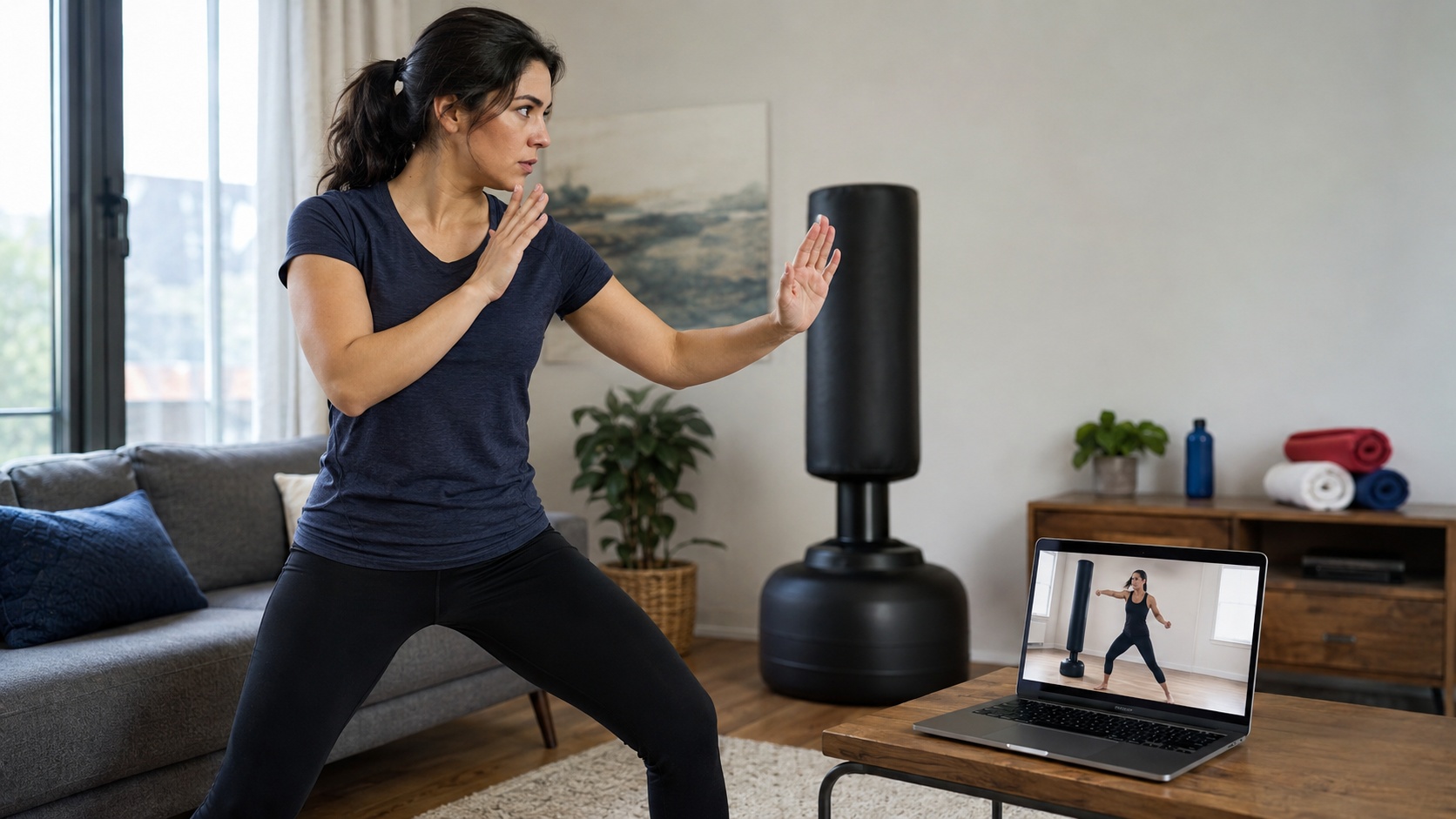
A good women’s self-defense plan does not promise that you will overpower every attacker. It prepares you to notice trouble earlier, set firm boundaries, protect yourself under pressure, create space, and escape.
That distinction matters. Real self-defense is not about winning a fair fight. An assault is not fair, predictable, or governed by rules. The goal is to interrupt the attack long enough to get away and reach safety.
Online self-defense classes can give beginners a practical starting point. They let you study at home, repeat lessons, and practice basic movements without committing to a long martial arts membership. They also have limits. A screen cannot correct your balance, recreate the stress of physical resistance, or safely replace supervised partner drills.
This guide explains what women should look for in self-defense training and evaluates the 60 Minute Self Defense Women’s Training Pack as an affordable online option.
Affiliate disclosure: USA Self Defense Centers may earn a commission if you purchase through links on this page. This does not increase your price. Our assessment is based on the course curriculum, instructor information, and offer terms published by The Self Defense Company. We have not completed or independently tested the members-only program.
Women’s Self-Defense at a Glance
| Question | Practical answer |
|---|---|
| What is the main objective? | Recognize danger, avoid escalation, create space, escape, and seek help. |
| Does strength matter? | Yes, but positioning, timing, leverage, surprise, and decision-making can help a smaller person create an escape opportunity. |
| Can an online course help? | Yes, as an introduction and home-practice framework. It is strongest when paired with careful repetition and occasional live coaching. |
| Is a weapon required? | No. A tool can add options, but it also introduces access, retention, legal, and training issues. |
| What is the best first step? | Learn a small set of simple responses and practice them regularly. |
What Effective Women’s Self-Defense Actually Covers
Women’s self-defense should not be a collection of flashy moves. It should be a layered personal-safety system.
Awareness Without Constant Fear
Situational awareness means noticing what is changing around you while continuing to live your life. It is not a demand to remain frightened or suspicious all day.
Useful habits include:
- Looking up before entering or leaving a vehicle
- Noticing who is nearby when approaching your home
- Keeping enough distance to react when a stranger makes you uncomfortable
- Identifying exits in parking structures, stores, hotels, and public transportation
- Moving toward people, light, security personnel, or an open business when something feels wrong
- Having your phone available without letting it absorb all your attention
Awareness works best when it triggers action. If a situation feels wrong, change direction, cross the street, enter a business, call someone, or leave. You do not owe a stranger continued access to you merely because you cannot prove that person has bad intentions.
Verbal Boundaries and De-Escalation
Physical techniques are only one part of practical self-defense. Women should also practice using a clear voice under pressure.
Short commands are easier to deliver than explanations:
- “Stop.”
- “Back up.”
- “Do not touch me.”
- “I need help.”
- “Call 911.”
Strong boundaries can attract witnesses, break social pressure, and make your intentions clear. De-escalation is useful when it creates safety. It does not require you to remain polite, stay within reach, or continue talking when you have a chance to leave.
Distance, Positioning, and Movement
Distance buys time. Time creates options.
A basic defensive position should protect your head while keeping your hands visible and ready. Your feet should allow you to move without crossing or tangling them. Whenever possible, angle toward an exit instead of backing into a wall, vehicle, or confined area.
Environmental positioning matters too. A table, shopping cart, parked vehicle, chair, or doorway can become a barrier. Creating an obstacle between yourself and a threatening person may be safer than trying to trade strikes at close range.
Breaking Contact and Creating Space
The most useful self-defense techniques are usually simple enough to perform when adrenaline is high. Training should address common problems such as wrist grabs, bear hugs, headlocks, being pinned, and attempts to drag or control you.
The tactical objective is not to remain engaged. Protect your head, stabilize your balance, attack the grip or position that is controlling you, create space, and move toward safety.
Strikes may be necessary to interrupt an assault. Open-hand strikes, elbows, knees, and low-line kicks can be easier for a beginner to use at close range than complicated combinations. Vulnerable targets may offer an opportunity to escape, but no target guarantees an instant stop. Pain can be delayed or ignored by an intoxicated, enraged, or highly motivated assailant.
Ground Survival and Safe Recovery
Many fights and assaults end up on the ground. Basic self-defense training should cover how to protect your head, frame against pressure, make room to move, and return to your feet without turning your back or giving up your balance.
Ground fighting is physically demanding. It also carries added risks when there are multiple attackers, weapons, or hard surfaces nearby. The priority remains escape, not winning a prolonged grappling match.
What Research Can and Cannot Tell Us
There is evidence that thoughtfully designed resistance education can help women. In a randomized trial involving 899 first-year university women, a 12-hour program that combined risk assessment, verbal resistance, and physical self-defense training reduced completed and attempted rape during the first year of follow-up.
That study supports the value of structured education and practice. It does not prove that every self-defense class works, and it does not validate the specific 60 Minute Self Defense course discussed below. The studied program was longer, delivered in person, and designed for a particular population.
That is the honest baseline: self-defense training can improve options, but no course can guarantee safety or transfer responsibility for violence from an offender to the victim.
Online Self-Defense Classes vs. Live Training
The right format depends on your budget, schedule, location, and comfort level.
| Training format | Best advantages | Main limitations | Best use |
|---|---|---|---|
| Online self-defense course | Private, affordable, repeatable, available on demand | No live correction or realistic resistance | Learning concepts and building a home-practice routine |
| Women-only live class | Supportive environment, instructor feedback, hands-on drills | Limited schedules and local availability | First supervised physical practice |
| Ongoing martial arts or combat-sports gym | Regular coaching, conditioning, progressive resistance | Greater cost and time commitment; sport rules may not match self-defense | Building durable movement and pressure-tested skills |
| Private instruction | Personalized coaching and controlled pacing | Usually the most expensive option | Addressing specific needs, injuries, or past experiences |
An online self-defense course is most useful when it gets you moving. Watching every lesson once is education, not training. Pause the video, practice slowly, repeat the movement, and revisit it until the response becomes familiar.
If you can add a reputable live class later, do it. Even a short session with a qualified instructor can reveal balance, distance, and technique problems that are difficult to notice alone.
Can Martial Arts Training Help Women Protect Themselves?
Yes. Boxing, kickboxing, Muay Thai, wrestling, judo, Brazilian jiu-jitsu, and other martial arts can build balance, timing, conditioning, body awareness, and the ability to respond under pressure. Regular training against a resisting partner also teaches lessons that cannot be learned by watching a video.
Sport training and self-defense are not identical, though. A tournament usually has rules, a prepared opponent, a known start, one-on-one engagement, and a safe training surface. A threatening situation may involve surprise, weapons, multiple people, confined spaces, or an immediate opportunity to run. The best approach is to keep the physical skills that pressure-tested martial arts develop while training your decision-making around escape.
Krav Maga and reality-based self-defense programs may address those scenarios more directly. Quality still varies by instructor. Look for safe practice, progressive resistance, clear explanations, and instructors who do not rely on fear or promise invincibility.
How to Choose an Online Self Defense Course
An online course should do more than collect dramatic demonstrations. Before paying, look for the following:
- A clear objective: The curriculum should prioritize personal safety and escape rather than prolonged fighting.
- Simple self-defense moves: Techniques should be easy to understand, adaptable, and realistic for a beginner.
- Qualified instruction: Review the instructor’s training, coaching background, and experience teaching ordinary people.
- Multiple camera angles and explanations: You should be able to see foot placement, posture, hand position, and the direction of movement.
- A practice plan: The course should tell you how to drill, not merely what to watch.
- Safety guidance: Responsible training explains what can be practiced alone, what needs a cooperative partner, and what requires professional supervision.
- Honest limitations: Be skeptical of anyone who guarantees that a single technique will paralyze an attacker or work in every situation.
- Clear purchase terms: Confirm access length, included modules, refund rules, and customer-support options.
The best self defense classes online help women build a repeatable practice habit. They should empower the student without creating false confidence.
60 Minute Self Defense Women’s Training Pack Review
The 60 Minute Self Defense Women’s Training Pack is sold by The Self Defense Company. It is designed as an entry-level online self-defense program for women and families who want practical instruction without years of traditional martial arts training.
What the Program Includes
According to the current sales page, the package includes two primary programs:
- 60 Minute Self Defense for teens and adults, covering attacker psychology, core self-defense principles, natural body weapons, ground defense, and responses to larger attackers.
- Family Safe for ages 5 to 12, covering safety rules, unsafe approaches by adults, safe strangers, separation in public places, bullying, and communication with first responders and caregivers.
The offer also lists three bonuses:
- A downloadable self-defense library
- An Elite Weapon Defense preview
- A Power Circuit interval-training routine based on techniques from the course
The seller states that one purchase provides lifetime access.
Price and Guarantee
At the time this article was prepared, the sales page listed the complete package at $39 and advertised a 30-day money-back guarantee. Prices, bonuses, and terms can change, so confirm the current offer before buying.
See the current 60 Minute Self Defense offer
Who Teaches the Course?
The program was created by Damian Ross, founder of The Self Defense Company. His published biography lists experience in combatives, judo, taekwondo, wrestling, kickboxing competition, coaching, bodyguard work, and firearms range safety. The company says Ross founded the business in 2007 and built the Self Defense Training System around the idea that a person should not need a black belt to learn essential protection skills.
Those credentials provide relevant background. They do not eliminate the need to judge the actual teaching by its clarity, safety, realism, and usefulness for your circumstances.
What We Like
- Low entry cost: At the listed $39 price, the financial commitment is far lower than most recurring martial arts memberships.
- Lifetime access: Repeat viewing matters for motor skills. You can revisit a lesson instead of trying to remember everything from a one-time seminar.
- Family coverage: The inclusion of an age-specific child-safety program makes the package useful beyond the adult course.
- Beginner focus: The program is marketed to people without previous training.
- Fitness component: The Power Circuit encourages active repetition instead of passive video consumption.
- Refund window: The published 30-day guarantee gives buyers time to inspect the course and decide whether the presentation fits them.
What to Keep in Mind
- It is not live coaching. An instructor cannot see and correct your posture, balance, timing, or unsafe practice habits.
- “60 minute” should not mean “mastered in 60 minutes.” The initial instruction may be concise, but dependable skill requires repetition.
- Seller statistics are not independent evidence. The sales page currently displays 2,742 “verified reviews” and more than 10,245 programs sold. We have not independently audited those figures.
- Some marketing claims are aggressive. Claims that one system works better than jiu-jitsu, Krav Maga, Muay Thai, karate, or MMA should be treated as promotional positioning, not a demonstrated universal fact.
- No technique guarantees incapacitation. Use the lessons to improve your chance to escape, not to develop false certainty that a particular move will instantly stop every attacker.
Our Verdict
The 60 Minute Self Defense Women’s Training Pack makes the most sense as a low-cost introduction and repeatable home-training framework. The current package includes adult, teen, child-safety, reference, and conditioning material for less than the typical price of one private lesson.
It is not a substitute for realistic, safely supervised practice. However, that does not make it useless. For a beginner who is not ready or able to attend a local class, a structured online program can be the step that turns vague interest into actual practice.
The key is how you use it. Watch actively. Drill slowly. Repeat often. Add live instruction when possible.
Review the current course package and guarantee
How to Practice Self-Defense Training Online
You do not need to turn your living room into a fight gym. You do need enough open space to move safely.
Start With Solo Movement
Practice your stance, hands-up position, footwork, turns, verbal commands, and movement toward a designated exit. Use a mirror or record yourself so you can check whether your hands drop or your feet cross.
Use Equipment That Forgives Mistakes
A focus mitt, kick shield, or freestanding bag lets you practice contact without striking another person. Begin slowly. Accuracy, balance, and recovery are more important than trying to hit as hard as possible.
Keep Partner Drills Controlled
If the course includes releases from grabs or holds, use a trusted partner and begin with light, predictable pressure. Agree on a stop signal. Do not apply eye, throat, neck, groin, or joint attacks with force during home practice.
Increase resistance only when both people understand the movement and can practice it safely. Complex restraints, weapon defenses, and high-impact throws belong under qualified supervision.
Practice Decisions, Not Just Motions
Add simple scenarios:
- Which direction is the exit?
- What object can become a barrier?
- When should you use your voice?
- When should you disengage and run?
- Where is your phone or personal alarm?
- Who can call emergency services?
Good self-defense training improves decisions as well as physical techniques.
Self-Defense Tools Are Options, Not Plans
Pepper spray, personal alarms, flashlights, stun devices, tactical pens, and other self-defense products may expand your options. None of them replaces awareness, access, practice, and judgment.
Before carrying any tool, ask four questions:
- Is it legal where I live and where I travel?
- Can I reach it quickly with either hand?
- Have I practiced deploying it safely?
- What will I do if it fails, is dropped, or is taken?
Pepper spray is popular because it can create distance, but laws, allowed formulations, and container limits vary. Read our Sabre pepper spray review and carry considerations before choosing a spray.
A knife is a particularly poor beginner shortcut. It requires close contact, can be taken, can cause lethal injury, and creates serious legal consequences. Training should come before shopping.
What Belongs in a Women’s Self-Defense Kit?
A practical kit is a collection of items you can legally carry, reach, and use. Depending on the person and location, it might include a charged phone, compact flashlight, loud personal alarm, keychain pepper spray, emergency contact information, and a small first-aid kit.
Avoid buying a preassembled kit merely because it contains many self-defense products. A mini stun gun, spray, or alarm does not help if it is buried at the bottom of a purse or pocket. Choose fewer tools, carry them consistently, and practice accessing them with either hand. Check state and local laws before carrying any defensive device.
Frequently Asked Questions
What Is the Best Self-Defense for a Woman?
The best self-defense is a layered system that matches the individual woman’s abilities, environment, and local laws. It should combine awareness, boundaries, distance management, simple escape-focused physical skills, and regular practice. A tool may support that system, but no single product is best for every person or situation.
What Are the Most Basic Self-Defense Skills?
Start with awareness, a strong verbal boundary, a balanced defensive stance, hands protecting the head, movement that preserves distance, basic releases from common grabs, safe recovery from the ground, and immediate escape once an opening appears.
These skills are less exciting than complicated demonstrations. They are also easier to remember and more adaptable under pressure.
How Do I Defend Myself in a Fight?
Avoid treating an assault like a contest. Protect your head, remain on your feet if possible, create distance, place barriers between yourself and the threat, draw attention, and escape. If physical force is necessary, use it to interrupt the attack and leave. Call emergency services as soon as you are safe.
Is It Legal to Defend Yourself if Someone Pushes You?
Possibly, but the answer depends on the facts and local law. In general, U.S. self-defense law looks at whether the threat was imminent and whether the defensive force was reasonable and proportionate. A push does not automatically justify any level of force, especially deadly force. Once the threat ends, retaliation is not self-defense. Consult the law in your jurisdiction or a qualified attorney for advice about a specific incident.
Can You Really Learn Self-Defense Online?
You can learn concepts, basic movement, home drills, and a practice structure through self-defense courses online. You cannot reproduce every benefit of a live class through video alone. The strongest approach uses online training for accessibility and repetition, then adds supervised practice when available.
How Often Should I Practice?
Two or three short sessions per week are usually more useful than one long session followed by months of inactivity. Even ten focused minutes can reinforce stance, movement, verbal commands, and access to a safety tool.
Are Women-Only Self-Defense Classes Better?
They can be more comfortable and can focus on common size disparities, boundary violations, sexual violence, and attack patterns that women may be especially concerned about. The quality of the instructor and the realism and safety of the training matter more than the label alone.
Build a Skill You Can Actually Use
The hardest self-defense technique to use is the one you watched once and never practiced.
Start small. Choose a course or class. Learn a stable stance, a clear boundary command, one way to protect your head, one method for creating space, and a plan for getting away. Practice until those actions no longer feel unfamiliar. Then add the next layer.
The 60 Minute Self Defense Women’s Training Pack offers a practical entry point for people who want to begin at home without a large financial or time commitment. Treat it as the start of your training, use the lifetime access, and build the habit of repetition.
See the current 60 Minute Self Defense Women’s Training Pack