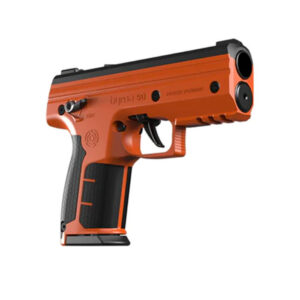
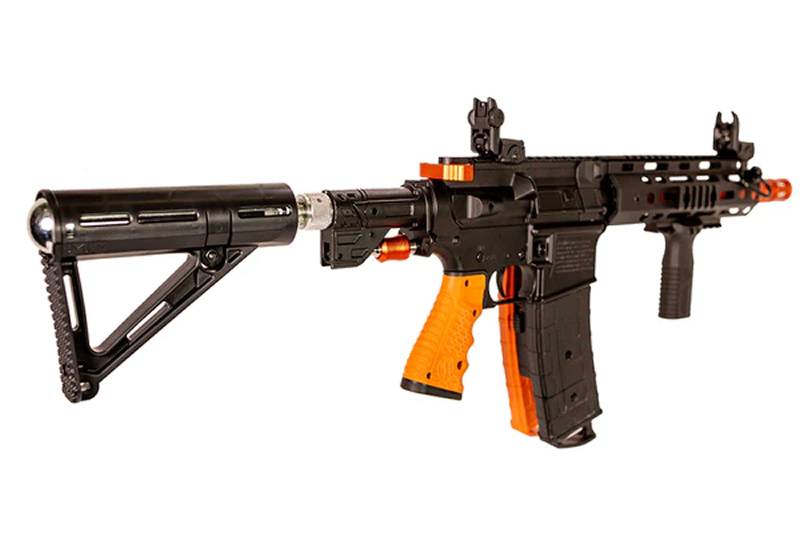
The Byrna Mission 4 makes a blunt pitch: shoulder-fired control, up to 38 defensive rounds on the platform, and enough gas for approximately 55 shots without introducing a conventional firearm into the home.
That combination deserves attention.
The Mission 4 is Byrna’s largest and highest-capacity consumer model. It launches .68-caliber kinetic or chemical-irritant payloads at approximately 325 FPS. A stock, foregrip, flip-up sights, and extensive accessory rails make it easier to control than a pistol-style Byrna.
It also has real limitations. It costs about $700 before ammo and optional upgrades. It is roughly the size of a conventional carbine. Its gas system also lacks the long-term stored readiness of Byrna’s pull-pierce pistols.
Here is the short verdict.
TLDR: The Byrna Mission 4 is the best model in the company’s lineup for buyers who prioritize capacity, range, and shoulder-fired control. It is especially compelling within a layered defense plan or for a household that does not want a lethal long gun. Buyers who need compact storage or instant readiness after months in a safe may prefer a Byrna SD or LE.
Editorial disclosure: This research-based Byrna Mission 4 review draws from current specifications, the owner’s manual, manufacturer training materials, independent demonstrations, and retail information. It is not presented as a hands-on range test.
Affiliate disclosure: We may earn a commission if you purchase through links on this page. This does not increase your price or affect our verdict.
[Check the Current Mission 4 Price]([BYRNA AFFILIATE LINK])
Byrna Mission 4 Specifications
| Specification | Mission 4 Kit |
|---|---|
| Caliber | .68 caliber |
| Power source | 88-gram CO2 cartridge |
| Muzzle velocity | Approximately 325 FPS |
| Advertised effective range | Up to 100 feet |
| Included mags | Two 19-round units with coupler |
| Maximum advertised capacity | 38 payloads |
| Conservative load | 18 per mag under certain carrying conditions |
| Shots per cartridge | Approximately 55 at room temperature |
| Energy density | 39.5 J/in² |
| Action | Semi-automatic pneumatic system |
| Receiver | Magnesium |
| Overall length | Approximately 31 to 32 inches |
| Weight | Approximately 6.13 pounds |
| Sights | Folding front and rear sights |
| Accessory system | M-LOK shroud with Picatinny rail sections |
| Current listed price | Approximately $699.99 |
Specifications, packages, and sale prices can change. Verify current details on Byrna’s product page before ordering.
How Much Does the Byrna Mission 4 Cost?
The standard Mission 4 Kit currently lists for approximately $699.99. Dealer sales may lower that figure, while expanded loadouts can cost more.
The purchase price is not the entire investment. A new owner should also budget for compatible practice balls, defensive payloads, replacement gas cylinders, a safe target and backstop, and secure storage. A light, optic, and sling are optional rather than mandatory.
At $700, this is not an impulse purchase. Its value comes from high capacity, a large propellant supply, a stable firing platform, and extensive upgrade support.
What Comes in the Current Kit?
Byrna currently includes:
- One Mission 4 launcher
- One gas adapter and stock
- One compact rifle bag
- Two coupled 19-round magazines
- Extra O-rings, lubricant, and an Allen key
- Two 88-gram CO2 cylinders
The base package does not currently list ammunition among the included equipment.
Older versions of the Byrna Mission 4 bundle sometimes included kinetic balls, extra gas, or other accessories. Some dealers still display those older contents. Compare what is actually inside the box, not just the bundle price.
What Is the Mission 4 Rifle?

This is a semi-automatic, shoulder-fired, CO2 powered less-lethal rifle. It feeds compatible .68-caliber balls from detachable magazines.
Its profile and controls resemble an AR-style long gun, but it does not fire bullets or conventional cartridges. The power comes from compressed gas installed beneath the stock. The operating system requires no batteries or electronics.
Some buyers call it a “non-lethal rifle.” Less-lethal is more accurate. The system is designed to reduce the probability of death compared with a traditional gun. It can still cause severe or fatal injury.
This is an actual weapon, not a toy or a consequence-free tool for threatening someone.
Mission 4 Power and Effective Range
Byrna rates the system at approximately 325 FPS, or roughly 221 miles per hour. Its current energy-density figure is 39.5 joules per square inch. An older official specification sheet lists approximately 13.5 to 20.5 joules of kinetic impact, depending on payload and conditions.
Energy density and total kinetic energy measure different things. Neither guarantees that one hit will stop every attacker.
Distance, clothing, impact location, ball construction, temperature, and the physical condition of the person struck all influence the result. Solid balls can cause intense pain, bruising, lacerations, and broken skin. Chemical payloads add eye, respiratory, and skin irritation.
This system provides substantial defensive force at a distance. It does not duplicate a firearm’s terminal effect or predictable stopping capability.
Is It the Most Powerful Non-Lethal Gun?
The Mission 4 is one of the most powerful and capable consumer less-lethal options in Byrna’s lineup, particularly when force, capacity, distance, and upgrade support are considered together.
Calling it the single most powerful non-lethal gun on the market would require standardized testing across competing devices and payload weights. That evidence is not available from one manufacturer’s data.
The defensible claim is narrower. It is Byrna’s highest-capacity, longest-range shoulder-fired consumer platform and one of the strongest complete options available to ordinary buyers.
What Does the 100-Foot Claim Mean?
The consumer page advertises an effective range of up to 100 feet. Byrna’s law enforcement agencies page provides more specific accuracy figures:
- Approximately 39 feet against a six-inch target
- Approximately 65 feet against an 18-inch target
- Up to 100 feet as the broader advertised figure
Do not interpret the headline number as guaranteed precision against a small target at 100 feet. Inside most homes, the more valuable benefits are stable controls and the ability to maintain distance.
Wind adds another variable when using chemical payloads. The released powder can move away from the threat or back toward the defender and other occupants.
The 38-Round Capacity Advantage
Capacity is one of the strongest reasons to choose this model.
Two coupled 19-round magazines provide a nominal total of 38. Once the first side is empty, the paired units can be removed, rotated, and reinserted.
The manual recommends loading 18 rather than 19 when the paired mags will be carried in a battle pack. Leaving one space reduces compression on fragile balls and may lower the chance of a rupture if the unit is dropped.
That produces two useful figures:
- Advertised maximum: 19 + 19, or 38
- Conservative practical load: 18 + 18, or 36
The sheer number of available shots matters. Less-lethal force does not guarantee immediate incapacitation. People miss under stress. Barriers interfere. A chemical ball may break in the wrong location. A determined attacker may require several effective hits.
There is also an unusual comparison with traditional firearms. Some states restrict firearm magazines to ten rounds or another specified limit. Because this device is powered by compressed gas rather than gunpowder, its two 19-round feed units may provide a substantial numerical advantage where lawful.
That does not make 38 Byrna rounds equivalent to 38 firearm cartridges. It means the defender has more opportunities to interrupt an attack, create distance, and reach safety without immediately resorting to lethal force.
Air-gun, chemical-agent, carrying, and discharge laws can still apply. Check the complete local rules rather than looking only at firearm magazine limits.
Using the Mission 4 for Layered Defense
No single weapon should be the entire home-security strategy.
Layered defense uses several independent barriers so that one failure does not leave the household exposed. Those layers can include:
- Exterior lighting and clear sightlines
- Reinforced doors, locks, and accessible windows
- Cameras, alarms, and early warning
- A family communication and safe-room plan
- A charged phone and rapid access to emergency services
- A less-lethal response option
- A firearm as a final lethal-force option, if the household chooses to keep one
The Mission 4 fits between passive security measures and lethal force. It can provide distance, visible deterrence, and substantial impact without making death the first likely result.
That middle layer can matter when dealing with an aggressive trespasser, an intoxicated relative, a person in crisis, or a dangerous animal. A threat may be serious even when the homeowner does not want a fatal outcome.
The device does not replace locked barriers, cover, retreat when feasible, or calling 911. It provides another response option.
A Less-Lethal Long Gun for Family Homes
Some households do not want a lethal long gun in the home.
The concern may involve children, inexperienced relatives, unauthorized access, accidental discharge, a family member experiencing a mental-health crisis, or a personal objection to lethal home defense. Those are legitimate risk calculations.
The Mission 4 offers a middle path. It provides rifle-like handling, meaningful stopping power, distance, and high capacity without storing conventional ammunition or introducing the same level of lethality.
That does not eliminate the need for a lock or safe. The device can seriously injure a child or bystander. Chemical agents can contaminate a room, while solid balls can ricochet from hard surfaces.
For a family that has decided against a conventional rifle but still wants a substantial shoulder-fired alternative, this is one of the most credible choices.
Does Less-Lethal Force Reduce Legal Risk?
It can reduce one critical risk: the probability that a defensive encounter ends in death.
If no one dies, the homeowner may avoid some of the gravest potential consequences associated with a fatal shooting, including a homicide investigation, possible homicide charges, and a wrongful-death lawsuit. That is meaningful.
It is not legal immunity.
Any intentional use of force can still result in:
- Police detention or arrest
- Seizure of the device as evidence
- Criminal investigation
- Assault or weapons charges
- A civil battery, negligence, or personal-injury claim
- Significant legal expenses even if the defender ultimately prevails
Self-defense generally depends on whether the response was lawful, necessary, and reasonable under the circumstances. A person cannot lawfully fire at someone merely for entering a yard, refusing to leave, insulting the homeowner, or taking property.
The Legal Information Institute’s overview of battery explains that self-defense may provide a defense when the response is reasonable under the circumstances. That requirement does not disappear because a device is marketed as less-lethal.
Still, there is a practical distinction. A painful impact or pepper exposure is generally easier to survive than a gunshot wound. Preventing a death can reduce moral trauma as well as criminal and civil exposure.
Never describe a Byrna as a way to shoot people without consequences. That claim is false.
The CO2 Readiness Tradeoff
An 88-gram cylinder supplies approximately 55 shots at room temperature. Cold weather can reduce pressure, velocity, consistency, and useful output.
A slide valve disconnects the gas supply from the firing system. That is useful between sessions, but it is not the pull-pierce technology found in Byrna’s pistol launchers.
Installing the large cylinder punctures it. The official Mission 4 owner’s manual says not to store the device while pressurized. It also instructs owners to remove the gas source and ammunition when the system is not being used.
That creates a genuine compromise. A unit stored strictly according to the manual requires more preparation than an SD or LE with an unpunctured pull-pierce cylinder.
Resolve that storage and readiness question before depending on the platform during an emergency. Ignoring the manufacturer’s warning is not a sound plan.
Payload Choices
Kinetic
Hard polymer balls rely on blunt impact and release no chemical agent. They avoid contaminating a room but can ricochet from walls, floors, and other hard surfaces.
Pepper and Max
Pepper balls break on impact and release irritant powder. Max versions combine chemical agents for a stronger effect. Wind and ventilation can expose the defender, other occupants, children, or pets.
Purchase and possession restrictions are also greater for chemical ammunition. Check Byrna’s current shipping restrictions and applicable law.
Training
Practice balls allow owners to learn the controls, test both feed units, confirm accuracy, and see how local temperatures affect performance.
Do not wait until an emergency to operate the system for the first time.
Best Mission 4 Upgrades and Accessories
The Mission 4 rifle arrives with usable sights and a vertical grip. Its M-LOK handguard and Picatinny rail sections create several useful upgrade paths.
- Weapon light: Helps identify whether an apparent intruder is actually a threat, family member, or person needing assistance.
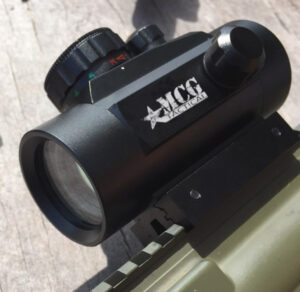
- Red-dot sight: Can simplify aiming, provided it is mounted securely and zeroed with the intended ammunition.
- Sling: Assists retention and frees both hands when calling emergency services or moving a family member.
- Practice supplies: Spare gas and training balls are more useful than cosmetic additions.
- Secure storage: A locking rack, cabinet, or safe may be the most important accessory in a family home.
A light and optic can improve usability, but equipment does not replace judgment or practice.
Advantages and Drawbacks
| Advantages | Drawbacks |
|---|---|
| Up to 38 defensive balls onboard | Approximately $700 before ammo and upgrades |
| Stable shoulder-fired controls | Large and difficult to store discreetly |
| Strong velocity and stand-off distance | Gas performance changes with temperature |
| Large propellant supply | Manual advises against pressurized storage |
| Kinetic, chemical, and practice choices | Chemical agents can affect occupants and bystanders |
| Extensive accessory support | Rifle-like appearance can cause misidentification |
| Lower probability of a fatal outcome than a firearm | No guarantee of incapacitation or freedom from legal action |
Byrna Mission 4 vs. TCR vs. LE
| Feature | Mission 4 | Byrna TCR | Byrna LE launcher |
|---|---|---|---|
| Platform | Full-sized long gun | Compact shoulder-fired model | Pistol format |
| Approximate price | $699.99 | $599.99 | $499.99 |
| Velocity | 325 FPS | 330 FPS | 330 FPS |
| Advertised distance | Up to 100 feet | Up to 60 feet | Up to 60 feet |
| Capacity | 19 + 19 | 12 + 7 | 5 |
| Estimated output per cylinder | 55 | 19 | 17 |
| Cylinder size | 88 gram | 12 gram | 12 gram |
| Best attribute | Maximum capacity and distance | Compact shoulder-fired handling | Portability and stored readiness |
| Main drawback | Size and storage compromise | Reduced capacity | Five-round limit |
Choose the Mission 4 when maximum capacity, property-defense distance, and rifle-like control matter most. Choose the TCR when maneuverability is more important. Choose the LE when compact storage and pull-pierce readiness take priority.
For additional comparisons, see our guide to the best non-lethal self-defense guns.
Reliability and Common Problems
The owner’s manual provides troubleshooting procedures for failures to fire, stuck triggers, ball or barrel obstructions, feeding problems, failure to puncture the cylinder, and hissing from a damaged seal.
These entries do not prove every unit will malfunction. They show why setup and testing matter.
Before relying on one:
- Read the complete manual.
- Learn how to unload and depressurize it safely.
- Test both mags with practice ammunition.
- Confirm the sights at realistic distances.
- Test performance in temperatures common to your area.
- Inspect seals, feed units, and defensive balls regularly.
The manufacturer warns against petroleum-based lubricants, incompatible ammunition, unauthorized gas cartridges, owner disassembly, and overtightening threaded components.
Is the Byrna Mission 4 Legal?
Byrna markets its launchers as legal to own in all 50 states without a firearm permit or background check. Ownership is only one part of the legal question.
Different rules may govern public carry, concealed carry, vehicle transportation, chemical agents, realistic weapons, and defensive use. A device may be lawful to purchase but unlawful to carry or discharge in a particular place.
California and New York buyers should consult our dedicated resources:
These resources are educational and are not substitutes for legal advice.
Frequently Asked Questions
Is the Mission 4 a firearm?
Byrna says no because it uses compressed gas rather than gunpowder. State and local laws can still regulate air-powered weapons, chemical payloads, carrying, and discharge.
How many rounds does it hold?
The two coupled feed units are advertised at 19 each, for a maximum of 38. The manual recommends 18 each under certain carrying conditions to reduce pressure on fragile balls.
Can you leave it pressurized?
The manual says not to store it under pressure and directs users to remove the gas source when the device is not in use. The on/off valve does not make a punctured cylinder unpunctured again.
Does the kit include ammo?
The current standard package does not list defensive or practice balls. Older retailer bundles may include them.
Can it stop an intruder?
It can deliver painful impacts or chemical irritants from a distance. No less-lethal weapon guarantees immediate incapacitation. Placement, distance, clothing, barriers, payload selection, and the attacker’s condition all matter.
Can it kill someone?
Potentially. Severe or fatal injuries are possible, particularly when the head, throat, chest, or another vulnerable area is struck.
Where can I buy or try it?
The Mission 4 is available directly from Byrna and authorized dealers. Some dealers and less-lethal training facilities offer demonstrations or range sessions. Confirm availability before traveling.
The Hard Baseline
The Byrna Mission 4 is not a firearm replacement in every emergency. It is a different defensive platform built around distance, high capacity, and a lower probability of death.
Its 36-to-38-round practical load is a genuine advantage. So are its shoulder-fired controls, large gas supply, and extensive upgrade support. For families that reject a lethal long gun but still want substantial stopping power, it fills a difficult gap.
The weaknesses remain important. It is expensive, carbine-sized, temperature-sensitive, and less convenient to store in a ready condition than Byrna’s pull-pierce pistols. It can also be mistaken for a conventional rifle.
Within a layered defense plan, however, the Mission 4 creates another option after locks, lights, alarms, and verbal warnings have failed but before lethal force becomes the only remaining answer.
Options create time. Time creates distance. Distance can keep a dangerous encounter from becoming a fatal one.