



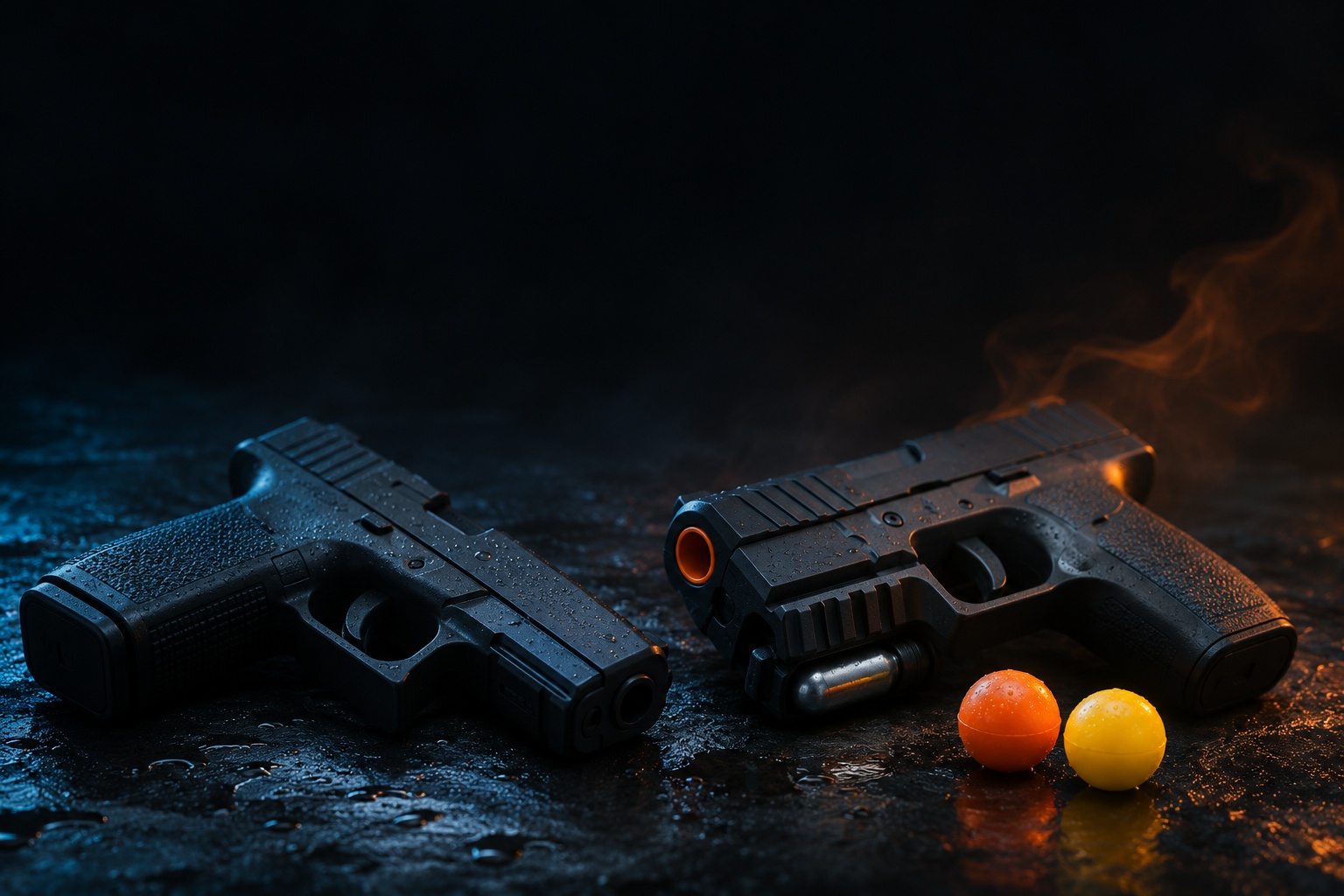
TL;DR: A Glock is a lethal firearm. A Byrna is a CO2-powered less-lethal launcher. They occupy roughly the same price range, which is why the comparison exists at all. The real decision isn’t about stopping power. It’s about which legal, financial, and emotional consequences you’re prepared to accept the moment you pull the trigger. For some situations, only a Glock will do. For many, a Byrna is the smarter tool. Neither one gets you out of understanding your state’s self-defense laws.
The question “Byrna or Glock” sounds like a product comparison. It isn’t. It’s a question about what kind of defender you want to be, what the law in your state actually allows, and what happens the day after you use the weapon in your hand.
A Glock 19 and a Byrna SD can live within a few hundred dollars of each other. You can rack a Byrna CL in your palm the same way you’d rack a compact 9mm. Both get stashed in nightstands, both ride in center consoles, both show up in the same self-defense conversations.
They are not interchangeable.
The Trope You Need to Retire
“I’d rather be judged by twelve than carried by six.”
Every self-defense forum repeats it. It sounds like wisdom. It isn’t advice. It’s a slogan that papers over the fact that a justified shooting can still end your career, drain your savings, and rearrange your relationships. The twelve people on the jury are only one of the consequences.
A clean shoot with a Glock gets you investigated. It can get you charged. In many states it exposes you to civil suit even after a prosecutor declines. Attorneys cost real money. The emotional weight of killing another person, even in defense of your life, is its own long-term cost.
The slogan isn’t wrong. It’s incomplete. If the threat is a lethal threat, a lethal response is the right one. If the threat isn’t yet at that line, a lethal response is also the one that drags the worst consequences into your life for the longest time.
A Byrna lives between those two outcomes. That’s its reason for existing.
What a Glock Actually Is
Shop Glock pistols: Check current models and pricing.
A Glock is a semiautomatic handgun. The Glock 19 fires 9mm Luger. The round leaves the barrel somewhere north of 1,100 feet per second. It will go through drywall. It will go through car doors. It will go through the attacker and keep going if the shot is not placed well.
Glocks are reliable, affordable by firearm standards, and dominant in both civilian carry and law enforcement. A new Glock 19 Gen6 generally runs $600 to $745 depending on dealer and configuration. Standard 9mm practice ammunition sits around $0.24 to $0.35 a round. Premium defensive rounds climb to a dollar or more each.
A Glock is designed to deliver lethal force. That is the entire point.
What a Byrna Actually Is
Shop Byrna launchers: On Amazon or direct from Byrna.
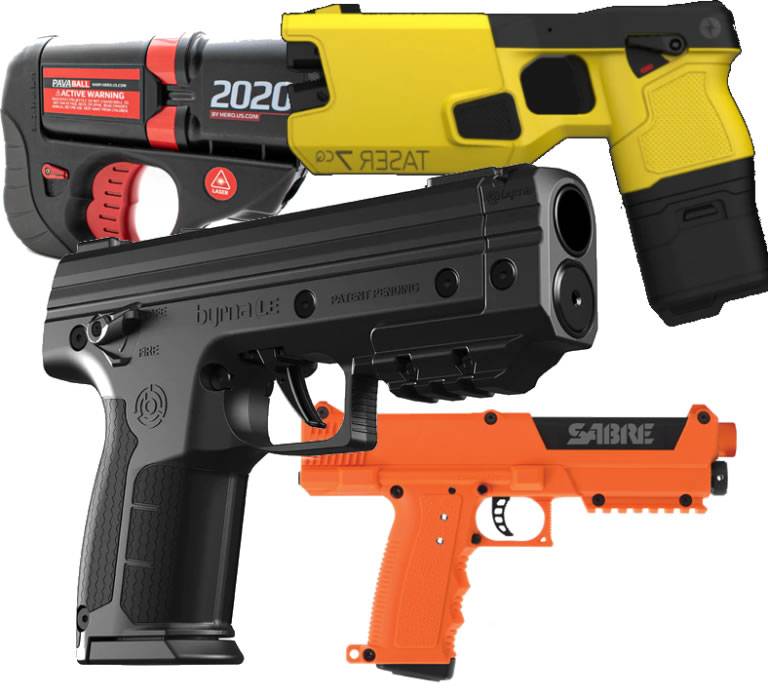
A Byrna is a CO2-powered launcher that fires .68-caliber or .61-caliber projectiles. Most models look like a handgun because they’re meant to. The silhouette is part of the deterrent.
Current launcher lineup and street pricing:
- Byrna SD — around $399, the mainstream model
- Byrna LE — around $499, larger, more capacity
- Byrna CL — around $549, compact
- Byrna CL-XL — around $579, compact with higher capacity
Byrnas fire four ammunition types that matter to a defender:
- Kinetic projectiles — hard polymer rounds that hit like a focused bruise, roughly $0.53 each
- Pepper projectiles — rupture on impact and release an OC/PAVA irritant cloud, roughly $5 each
- Max projectiles — enhanced irritant blend including CS, roughly $6 each
- Eco-Kinetic and Pro training rounds — $0.42 to $0.84 each, used for practice
Byrna launchers aren’t federally classified as firearms. No ATF form, no FFL transfer, no background check at the point of sale. That alone changes the entire ownership profile.
The Legal Weight of Pulling a Trigger
This is where the comparison stops being about gear.
American self-defense law is not uniform. There is no national rule. Fifty states plus federal jurisdictions means fifty-plus variations on when deadly force is justified, what duty to retreat looks like, and what happens when a jury second-guesses your decision.
Three concepts you need to understand before you buy either weapon.
Castle Doctrine
Castle doctrine says you have no duty to retreat from an attacker who unlawfully enters your home. Most states recognize some version of it. Some extend it to your vehicle or workplace.
Castle doctrine is not permission to shoot anyone who walks through your door. It removes the retreat requirement. It does not remove the requirement that you reasonably believe the intruder poses a threat of death or serious bodily injury. A drunk neighbor stumbling into the wrong house is not automatically a lawful target.
Stand Your Ground
Stand your ground laws extend the no-duty-to-retreat principle outside the home. If you’re legally allowed to be where you are, you don’t have to run before defending yourself.
Stand your ground is not a license. It is still subject to the underlying justification requirements. You still have to show you reasonably believed deadly force was necessary. The confrontation still can’t be one you provoked. Prosecutors in SYG states have charged shooters whose facts didn’t line up.
Duty to Retreat
A handful of states, including several in the Northeast, require you to retreat if you can safely do so before using deadly force outside your home. Massachusetts, New York, and New Jersey are examples. If you live in or travel through one of these states, your legal exposure after a Glock shooting is materially higher than for someone in a Texas or Florida equivalent.
The baseline rule for every state: deadly force requires a reasonable belief in imminent death, serious bodily injury, or certain enumerated violent crimes. “He scared me” is not the standard. “He wouldn’t leave” is not the standard. “I had the right to be there” is not by itself a defense.
Different states have different standards. Know yours before you need to.
What Happens Legally When You Use a Byrna
Less-lethal is not consequence-free. Say it twice.
A Byrna is a weapon. Discharging one at another person is a use of force. If the force wasn’t justified under your state’s law, you can be charged with assault, battery, reckless endangerment, or a weapons offense. The victim can sue you civilly.
What changes is the threshold.
Many states draw a sharper line between deadly force and nondeadly force than casual readers realize. Nondeadly defensive force is often permissible in situations where deadly force would not be. A reasonable response to a non-weapon physical assault, for example, might include a Byrna round and would almost certainly not include a 9mm.
That lower threshold is the Byrna’s legal advantage. You can defend yourself proportionally in situations that don’t meet the deadly-force bar. You still have to show the use of force was reasonable. You still have to show the threat was real. You just don’t have to prove the threat was lethal.
Misuse still gets you charged. A Byrna fired at someone walking away, someone unarmed and non-threatening, or someone whose only crime was annoying you lands the same place a Glock would.
CCW, Permits, and the Carry Question
Carrying a Glock
Depends on your state. Permitless-carry states (sometimes called constitutional carry) let eligible adults carry a concealed handgun without a permit. Other states require a license, training, fingerprints, fees, and sometimes a wait.
Purchasing from a federally licensed dealer requires a background check. Handgun purchases from an FFL require you to be 21 under federal law. Some states layer on additional requirements: waiting periods, purchase permits, magazine capacity limits, red-flag procedures.
Interstate travel adds complexity. Reciprocity is uneven. A permit valid in your home state may be worthless two state lines over.
Carrying a Byrna
Generally no concealed carry permit required. Byrna launchers are not firearms under federal law, so federal firearm licensing doesn’t apply.
This is one of the most practical reasons people buy them.
If you live in a may-issue state, or a shall-issue state with a slow permit process, or you simply don’t want to engage with the firearm licensing bureaucracy, a Byrna puts a defensive tool in your hand without any of that friction. The purchase itself usually ships to your door with no background check.
The caveats are real:
- New York City, Washington DC, Portland, and other local jurisdictions restrict possession or specific ammunition types
- California and New York State restrict chemical projectiles even where kinetic rounds are legal
- Some states regulate pepper spray and chemical weapons independently of firearm law, and those rules reach Byrna chemical ammunition
Check your state and city before you order. Legal to own and legal to carry concealed in a specific location are two different questions.
In the Car
Vehicle carry of a loaded handgun is governed by state firearm law, carry permit status, and in some states a specific vehicle-carry provision. Some states let an eligible adult keep a loaded handgun in a personal vehicle without a permit. Others require the firearm to be unloaded and stowed in a specific way during transport.
Byrnas face far fewer restrictions in a vehicle in most jurisdictions. The launcher itself usually isn’t regulated as a firearm, and the ammunition typically isn’t either. Some states do restrict chemical irritants and may still reach the pepper rounds specifically.
Leaving any weapon in an unattended vehicle is a theft risk you accept. That part doesn’t change.
Overpenetration: The Missed-Shot Problem Nobody Buys a Gun to Think About
A 9mm defensive round doesn’t stop when it hits what you aimed at. It stops when it runs out of energy. Standard interior drywall is not an energy sink. Neither is a hollow-core door, a car door, or a human torso.
If you fire a Glock inside your home and miss, that round continues through the next wall, into the next room, and potentially through the exterior. If a family member is in the adjacent room, your defensive shot becomes the thing you spend the rest of your life regretting.
Defensive ammunition is engineered to minimize overpenetration. Hollow points expand, dump energy faster, and penetrate less than FMJ. “Less” is relative. Hollow points still clear drywall. They still travel farther than most defenders assume.
Overpenetration is why police and civilians who train seriously think about shot placement, backstops, and what’s behind the target. It’s also why the home-defense conversation often moves toward shotguns loaded with specific shot sizes rather than handguns.
A Byrna behaves differently when it misses.
A kinetic round that strikes drywall leaves a mark and stops. A chemical round that strikes drywall ruptures and disperses an irritant cloud roughly three to five feet across. The cloud is indiscriminate. It will reach the attacker if the geometry works. It will also reach you, your family, and your dog. In an enclosed space, that becomes its own problem.
The point is not that a Byrna miss is safe. The point is that a Byrna miss is unlikely to kill a sleeping child two rooms away.
The Pepper Cloud: Why a Near Miss Still Works
Chemical Byrna projectiles are engineered to burst on impact. When they rupture against an attacker or a nearby surface, powdered OC, PAVA, and in the case of Max rounds, CS, disperses into the air.
Three practical effects follow.
You don’t have to land a direct hit. A chemical round that bursts near the attacker’s face, chest, or feet exposes them to the irritant. Shooting under stress is hard. A tool that still works when you miss by a foot is more forgiving than a tool that requires precise placement.
One round can affect more than one person. If two or three attackers are clustered, a single projectile that ruptures in the middle of them can expose all of them. A Glock does not do this. A single 9mm round addresses one attacker and continues on its path.
The cloud is also a problem. It doesn’t distinguish between threats and bystanders. It doesn’t distinguish between the attacker and you. In an enclosed space, in a vehicle, or in a hallway, the operator can get a face full of their own round. Train for this.
Chemical rounds are not reliable incapacitators either. A determined, drug-affected, or highly motivated attacker can push through pepper exposure for the critical seconds that matter. Treat the cloud as a disruption, not a stop.
Rounds Aren’t Free
The sticker on the box is only the beginning.
Byrna Ammunition
Chemical defense rounds are expensive per shot:
- Pepper projectiles: around $25 for a 5-pack, so $5 per round
- Max projectiles: around $30 for a 5-pack, so $6 per round
- Kinetic rounds: around $50 for 95 rounds, so about $0.53 per round
- Eco-Kinetic training rounds: around $40 for 95, so $0.42 per round
CO2 cartridges run around $2 each in bulk packs. Each cartridge drives a limited number of shots, varying by model and temperature.
Chemical ammunition also has a shelf life. Unused rounds expire. Factor that into your replacement schedule.
9mm Ammunition
Standard range ammunition sits around $0.24 to $0.35 per round. Defensive hollow points generally run $0.60 to $1.50 per round. A fifty-round box of practice ammo costs less than a single five-pack of Byrna Pepper rounds.
If you train seriously, a Glock is cheaper to feed over time. If you shoot a few rounds a year to check function and otherwise rely on the weapon staying loaded, the per-shot cost gap matters less than the upfront price.
When a Glock Is the Right Call
A Glock wins when the threat is a weapon.
An attacker with a knife at close range, a firearm, a club, or multiple attackers armed with any of those is a deadly-force situation. A Byrna is not designed to resolve that. Pepper doesn’t stop a knife attack reliably. Kinetic rounds don’t out-reach a firearm.
A Glock also wins when you need volume and reliability. CO2 fades in cold weather. Chemical rounds have shelf life. 9mm cartridges, stored properly, keep for decades.
If you are legally eligible to own a handgun, willing to put in training time, and prepared to accept the legal and emotional weight of using one, a Glock is a serious defensive tool for serious threats.
When a Byrna Is the Smarter Choice
A Byrna wins when the threat is not clearly a deadly-force threat.
A home intruder you can’t immediately identify as armed. A road-rage escalation. An aggressive stranger in a parking lot who hasn’t produced a weapon. A domestic situation where lethal force would be a legal and personal catastrophe but doing nothing isn’t an option.
A Byrna also wins for people who want a defensive tool without the firearm licensing process, people who don’t want a lethal weapon in a house with young children, and people who travel across state lines frequently and don’t want to re-check reciprocity every time.
The chemical cloud is a genuine advantage against multiple attackers or in situations where your shot placement under stress is going to be imperfect.
Owning both is reasonable. Many defenders keep a less-lethal option as the first tool they reach for and a firearm available for the subset of threats that require it. Decide which is which before the situation decides for you.
The Problem With Looking Like a Real Gun
A Byrna looks like a Glock on purpose. The deterrent value depends on the attacker believing they’re facing a firearm.
The silhouette cuts both ways.
A responding police officer who sees you holding a Byrna sees you holding what looks like a handgun. In the three-second window a cop uses to decide whether to shoot, the ATF classification of your tool is not going to be known. A bystander calling 911 reports a man with a gun. A follow-up officer who arrives after the fact walks into the same ambiguity.
Don’t display a Byrna any more carelessly than you would display a firearm. The legal classification doesn’t change how it reads to the human on the other end.
The Question You Have to Answer First
Before you choose, decide what you’re willing to do with the weapon you’re carrying.
If you are prepared to kill another human being in a legally defensible circumstance and accept everything that follows, a Glock belongs on your hip or in your nightstand. Train with it. Understand your state’s deadly-force law in detail. Carry insurance.
If you want a serious defensive option that keeps lethal consequences off the table unless things escalate beyond your control, a Byrna earns its place. Train with it too. The CO2 system, the different ammunition types, and the launcher’s behavior under stress all deserve range time. Understand that less-lethal doesn’t mean legally free, and that the appearance of the weapon can still get you shot by someone who assumes it’s real.
The worst answer is the one that treats either tool as magic.
If you are prepared to kill another human being in a legally defensible circumstance and accept everything that follows, a Glock belongs on your hip or in your nightstand. Train with it. Understand your state’s deadly-force law in detail. Carry insurance. Shop current Glock models.
If you want a serious defensive option that keeps lethal consequences off the table unless things escalate beyond your control, a Byrna earns its place. Train with it too. The CO2 system, the different ammunition types, and the launcher’s behavior under stress all deserve range time. Understand that less-lethal doesn’t mean legally free, and that the appearance of the weapon can still get you shot by someone who assumes it’s real. Shop Byrna on Amazon or buy direct from Byrna.
Key Takeaways
- A Glock is a lethal firearm. A Byrna is a CO2-powered less-lethal launcher. Choose the tool that matches the threshold of force your state allows and the kind of threat you expect.
- Deadly force law varies by state. Castle doctrine, stand your ground, and duty-to-retreat rules all affect what happens the day after a shooting. Know your state’s standard before you buy.
- “I’d rather be judged by twelve” ignores the attorney fees, civil liability, and lifelong weight that come with a shooting even when the shoot is clean.
- Byrna launchers generally do not require a concealed carry permit, do not require a background check at purchase, and face fewer vehicle carry restrictions. Local and state rules on chemical ammunition still apply.
- A missed 9mm round keeps going. A missed Byrna chemical round releases a three-to-five-foot cloud that works on near misses but is indiscriminate in enclosed spaces.
- Byrna chemical rounds cost around $5 each. 9mm practice ammunition costs under $0.35 a round. Train accordingly.
- A Byrna’s firearm-like appearance is a deterrent for attackers and a liability with responding police. Don’t display it carelessly.
- Owning both is reasonable. Reach for the less-lethal first when the law and the threat allow, and the firearm when they don’t.