





Can you really learn self defense online, or do you need to spend months training at a martial arts school? The short answer is yes, you can learn quite a bit online. And with the right approach, you can develop some practical skills without ever setting foot inside a traditional martial arts school. Of course, […]
Can you really learn self defense online, or do you need to spend months training at a martial arts school?
The short answer is yes, you can learn quite a bit online. And with the right approach, you can develop some practical skills without ever setting foot inside a traditional martial arts school.
Of course, there’s a difference between watching a self defense video and actually training.
Someone who watches a few demonstrations and never practices the movements isn’t going to get the same results as someone who follows a structured course, practices regularly, and works with a training partner.
That’s an important distinction.
Online self defense courses have also improved considerably. Today, you can find everything from introductory personal safety lessons to complete martial arts and combatives programs featuring experienced instructors, detailed demonstrations, partner drills, and opportunities for remote feedback.
Will these programs completely replace hands-on instruction from a qualified trainer? Not necessarily.
But they can provide a legitimate and affordable way to build useful skills.
Let’s look at what online self defense training can accomplish, which programs are worth investigating, and how to get the most out of learning at home.
BLUF: Is Learning Self Defense Online Worth It?
Absolutely. Online self defense training can be an effective way to learn personal safety concepts, develop foundational physical skills, and practice defensive techniques, particularly when you actively train rather than simply watch videos.
Here’s what matters:
- Online courses can teach situational awareness, de-escalation, defensive positioning, and practical self defense techniques.
- Learning with a training partner allows you to practice movements against controlled resistance, making online instruction considerably more useful.
- Solo training and mental rehearsal can reinforce movement patterns and defensive decision-making.
- Many programs provide structured instruction that can be reviewed repeatedly, something that isn’t always possible during a live class.
- Qualified in-person instructors offer important advantages, particularly when correcting technique, introducing resistance, and supervising higher-risk exercises.
- The strongest approach combines good instruction, consistent practice, realistic expectations, and progressively more challenging training.
The important thing is to actually train.
Watching a video might teach you what to do. Practicing helps you understand how to do it.
Can You Really Learn Self Defense Online?
Consider how people learn other physical skills.
You can study boxing techniques through video instruction, practice footwork and combinations at home, and work on a heavy bag without attending formal classes.
You can also learn the mechanics of Brazilian Jiu Jitsu, study escapes, and practice grappling movements with a willing partner.
Martial artists have used instructional books, videos, seminars, and home training routines for decades.
Online education simply makes these resources more accessible.
The question isn’t whether learning from video is possible.
It’s whether the student is getting enough practice, feedback, and progressively challenging training to turn instruction into usable skills.
Watching Videos Is Only the Beginning
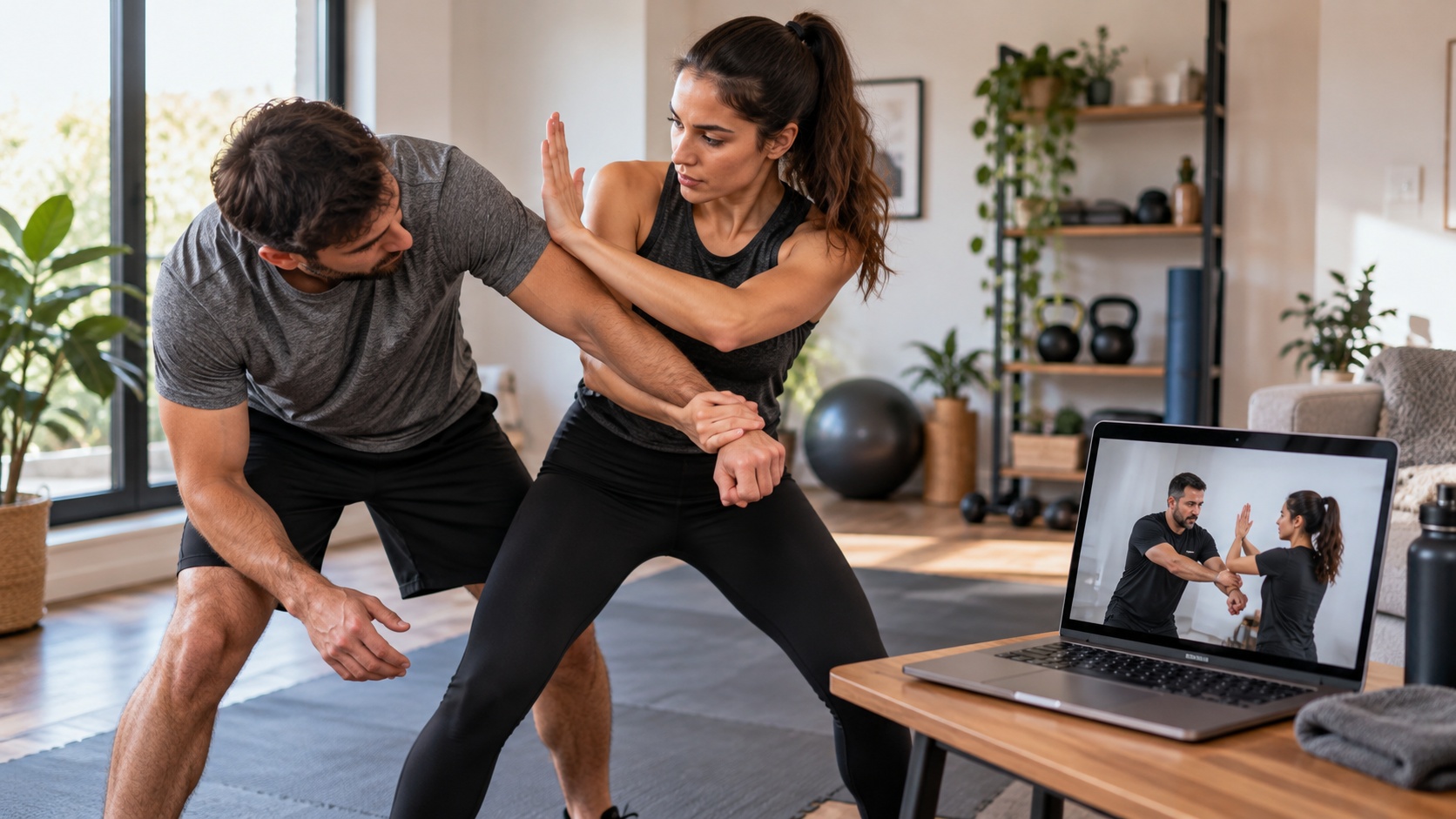
Suppose you’re watching a lesson demonstrating how to respond when someone grabs your wrist.
The instructor explains the movement, shows the positioning, and demonstrates the escape from several angles.
That’s useful information.
But you can take things further.
First, study the demonstration and rehearse the movement slowly. Then practice with a cooperative partner who understands the technique.
Once the movement becomes familiar, you can introduce modest, controlled resistance, provided the drill is appropriate for unsupervised practice and neither participant is being put at risk.
This introduces variables that aren’t present when practicing alone.
Your partner might move differently, react at a different speed, or provide feedback about your positioning.
You’re no longer simply memorizing a demonstration. You’re beginning to apply what you’ve learned.
Naturally, the more demanding the technique becomes, the more valuable qualified supervision is. Chokeholds, joint locks, throws, and other potentially injurious techniques shouldn’t be improvised with an inexperienced partner.
Training with a Partner Can Close Some of the Gap
One of the biggest criticisms of online martial arts training is that students don’t experience physical resistance.
But this criticism assumes they’re training alone.
An online course combined with a capable training partner can address some of the limitations of video-only instruction.
There are several ways to structure practice.
| Training Method | What It Helps Develop |
|---|---|
| Watching instructional videos | Understanding techniques and defensive principles |
| Solo movement drills | Coordination, balance, positioning, and repetition |
| Cooperative partner practice | Distance, timing, and executing movements with another person |
| Controlled progressive resistance | Adaptability when a partner doesn’t simply cooperate |
| Mental rehearsal | Focus, familiarity, and defensive decision-making |
| Supervised live training | Technical feedback, safe resistance, and realistic application |
The progression matters.
Students shouldn’t jump straight from watching a demonstration to trying techniques at full speed against a resisting partner.
Begin with cooperative practice. Establish safety rules and a clear stop signal. Introduce only low-risk resistance suited to your experience and training environment.
If possible, periodically train with a qualified instructor who can assess your progress and correct mistakes.
A home training partner may help bridge the gap between online instruction and supervised classes, even though they cannot provide every advantage of an experienced coach.
Visualization: Why Mental Rehearsal Matters in Self Defense
There’s another part of training that often gets overlooked.
Visualization.
Professional fighters, martial artists, and athletes have long used mental rehearsal to prepare for competition and improve their performance.
And there’s research supporting its value.
A 2025 systematic review and meta-analysis published in Behavioral Sciences examined 86 studies involving 3,593 athletes. The researchers found that imagery practice improved athletic performance across several areas, although outcomes varied by activity and training method.
That doesn’t mean imagining yourself defending against an attacker will automatically make you capable of doing so.
It does suggest that mental practice can make a useful contribution to a broader training program.
How Martial Artists Use Visualization
Imagine you’re learning a defensive movement.
You’ve watched the instructor demonstrate the technique, practiced it slowly, and worked through it with a partner.
Later, when you don’t have anyone available to train with, you mentally rehearse the movement.
You picture your balance, positioning, timing, and what you intend to do next.
Rather than imagining a guaranteed successful outcome, consider different responses and potential complications.
For civilian self defense, visualization can also involve nonphysical decisions.
For example, imagine realizing that an argument in a parking lot is escalating.
Mentally rehearse recognizing the warning signs, establishing a verbal boundary, maintaining distance, and moving toward a safer location.
This type of preparation doesn’t require expensive equipment or a training facility.
The Science Behind Mental Rehearsal
Mental imagery engages some of the neural processes involved in planning and executing physical movements.
Research has found that combining mental and physical practice can improve motor learning and performance in certain circumstances.
A 2023 systematic review of physical and mental practice also examined how these approaches affect motor skill learning.
Several useful resources explain how visualization fits into combat sports:
- The Role of Visualization in Martial Arts Success, published by Ground Standard, explores mental imagery, focus, and training consistency.
- Visualization Techniques Used by MMA Fighters, published by Marketing Source, examines how fighters incorporate mental rehearsal into their preparation.
- The Science of Visualization: How Mental Rehearsal Enhances Performance of a Fighter, from Evolve University, discusses the connection between visualization and physical performance.
The takeaway is straightforward.
Mental rehearsal has value, especially when it reinforces movements and decisions you’ve already practiced physically.
It shouldn’t replace physical training, but it can certainly complement it.
The Most Important Self Defense Skills You Can Learn at Home
You don’t need to memorize dozens of elaborate techniques to begin developing useful defense skills.
Start with fundamentals.
1. Situational Awareness and Recognizing Danger
Situational awareness involves understanding your surroundings, recognizing unusual behavior, and noticing changes that might indicate trouble.
For example, imagine walking through a nearly empty parking garage.
Rather than concentrating entirely on your phone, look around. Identify nearby exits, occupied areas, and anything that might require additional caution.
You don’t need to treat everyone as a threat.
The objective is to remain observant without becoming paranoid.
Practice maintaining awareness when entering unfamiliar environments, recognizing potential escape routes, and avoiding unnecessary isolation.
These are skills you can develop independently.
2. Verbal Boundaries and De-Escalation
Not every confrontation becomes physical.
Sometimes the best response is to create distance while clearly communicating your intentions.
Practice statements such as:
“Stop. Stay back.”
“I don’t want any trouble.”
“Do not touch me.”
Your tone should be firm without unnecessarily provoking the other person.
Role-playing with a partner can add value here.
Have your partner present a mild, fictional confrontation while you practice maintaining space, communicating boundaries, and disengaging.
Keep the exercise controlled and avoid turning it into an actual argument.
3. Defensive Stance and Movement
Basic movement is one of the easiest skills to practice at home.
Start with a comfortable athletic stance, knees slightly bent, and feet positioned to maintain balance.
Practice moving forward, backward, and sideways without losing your footing.
You can rehearse these movements alone or use a cooperative partner to practice maintaining distance.
As your coordination improves, introduce simple movement changes and reactions to visual cues.
A good instructor can later correct problems with your stance, footwork, and positioning.
4. Basic Defensive Movements and Escapes
Many online self defense programs demonstrate defensive postures, methods of creating distance, and simple escape concepts.
Some of these can be practiced safely at home.
For instance, a partner can help you rehearse maintaining personal space, moving around obstacles, and disengaging from low-risk simulated contact.
Avoid turning home drills into unsupervised contests of strength.
Techniques involving potentially dangerous pressure on the neck, joints, or spine require appropriate facilities and experienced supervision.
The goal is to develop reliable fundamentals, not prove how much punishment either training partner can tolerate.
5. Using Pepper Spray and Other Defensive Tools
Some online courses also teach how to handle pepper spray, personal alarms, and other defensive equipment.
This is particularly useful for people who carry self defense tools but have never received instruction.
An inert practice canister, for example, can help you become familiar with the controls and safe handling of a pepper spray device.
You can rehearse accessing the equipment without releasing live irritants.
Read the manufacturer’s instructions, understand the relevant laws, and never assume a defensive tool will work perfectly in every situation.
Our SABRE pepper spray review explores an everyday-carry option and its practical considerations.
Best Online Self Defense Courses and Training Programs
There’s a growing selection of online self defense classes covering everything from general personal safety to combatives, grappling, and martial arts.
Some offer introductory lessons, while others provide extensive libraries and structured courses.
Here are several options worth investigating.
These descriptions are based on the providers’ published materials, not independent hands-on testing.
Alison: Free Self Defense Training for Beginners
Alison’s Introduction to Self-Defense for Beginners is a useful starting point for anyone who wants to explore basic self defense concepts without immediately purchasing a course.
Its lessons introduce common defensive situations and fundamental responses.
It’s particularly suitable for someone who wants to become familiar with the subject before moving into more extensive physical training.
The learning content is free, although additional credentials may carry fees.
ProTrainings: Structured Online Self Defense Lessons
ProTrainings offers an organized course containing 22 instructional videos.
The program covers topics such as situational awareness, hand-to-hand defensive concepts, pepper spray, grabs, and methods of practicing without a partner.
One advantage of a structured course is that students can revisit specific lessons repeatedly instead of jumping between unrelated videos.
ProTrainings also offers a completion credential, although completing online lessons shouldn’t be confused with demonstrating physical proficiency.
REAL LIFE Self-Defense: Practical Instruction from Mike Gillette
REAL LIFE Self-Defense is another program worth examining for people interested in practical defensive training.
Created around instruction from Mike Gillette, the program emphasizes straightforward techniques, mental preparation, and recognizing dangerous situations.
Its video lessons are presented in manageable segments, allowing students to review the material and practice at their own pace.
One appealing aspect is the emphasis on psychological preparation alongside physical techniques.
Understanding aggressive behavior, managing fear, and making sound decisions are important parts of personal protection.
The program is marketed as accessible to people with different fitness levels and experience.
As with any course, students should distinguish useful instruction from promotional promises. No training system can guarantee success against every attacker.
Still, for someone looking for an alternative to conventional martial arts lessons, REAL LIFE Self-Defense offers another avenue to explore.
The Self Defense Company: Online Combatives and Specialized Programs
The Self Defense Company offers a collection of online programs developed around the instruction of Damian Ross.
The company emphasizes practical combatives, personal protection, situational awareness, and techniques intended for real-world defensive encounters.
It also offers multiple programs for different interests and experience levels.
Combatives Fast Course
The Combatives Fast Course introduces foundational defensive concepts, positioning, balance, and responses to physical confrontations.
It’s designed for people seeking a relatively focused introduction rather than a traditional martial arts curriculum.
Combatives Fast Course Grappling
The grappling-focused course provides another option for students interested in how grappling fits into a combatives-oriented system.
Because grappling involves close physical contact and significant resistance, hands-on partner training becomes particularly important.
One Shot Fight Enders
One Shot Fight Enders emphasizes striking concepts and techniques intended to create an immediate defensive advantage.
Students should approach claims about instantly ending fights with appropriate skepticism. Real confrontations are unpredictable, and no single strike can be relied upon to stop every attacker.
Operation Phoenix
Operation Phoenix is a more advanced program focused on potentially lethal combatives and serious use-of-force situations.
This material is not an appropriate starting point for every beginner. Students should understand the physical risks, legal implications, and importance of qualified instruction before pursuing advanced combatives.
Aware Course
The Aware Course focuses on threat awareness, everyday movement, personal protection habits, and recognizing potentially dangerous situations.
This may be particularly relevant to beginners because awareness and avoidance are useful regardless of physical ability.
Despite the word “free” in the URL, readers should check the current enrollment terms before assuming the entire course is available without charge.
60 Minute Self Defense Women’s Training
The company also offers a 60 Minute Self Defense Women’s Training program.
This option is aimed at women looking for a shorter introduction to practical defensive concepts.
Together, these programs demonstrate how varied online training has become.
Students can select introductory courses, review specialized topics, and build a training routine around their schedules.
One practical consideration: some of The Self Defense Company’s offerings have limited access periods. Review the current terms, costs, and refund policies before purchasing.
Gracie University: Women Empowered and Brazilian Jiu Jitsu
Gracie University provides structured Brazilian Jiu Jitsu instruction, including its Women Empowered program.
The curriculum emphasizes leverage, grappling, positioning, and defending against physical restraint.
Some courses provide opportunities to submit video demonstrations for evaluation.
That additional feedback can make a difference.
It’s one thing to believe you’re performing a technique correctly. It’s another to receive corrections from someone who understands its mechanics.
Students interested in grappling should still seek qualified supervision for partner drills that involve significant pressure, locks, or submissions.
How to Choose a Legitimate Online Self Defense Course
Not every online program deserves your time or money.
Some instructors have substantial experience. Others appear to base their credentials primarily on producing dramatic videos.
Before choosing a program, consider the following.
Instructor Experience
Look for instructors who explain their training background and demonstrate a clear understanding of the techniques they’re teaching.
Experience in boxing, Krav Maga, Brazilian Jiu Jitsu, Muay Thai, wrestling, or other martial arts may be relevant.
So can experience teaching civilian personal protection.
But credentials alone aren’t enough.
A good instructor should be able to explain techniques clearly, recognize common mistakes, and acknowledge limitations.
Structured Training and Practice
A course should provide a logical progression.
Learning basic movement and positioning before attempting complicated techniques makes sense.
Programs that include review exercises, practice suggestions, and partner drills offer more opportunities to translate information into skills.
Look for instruction that explains not only what to practice, but also how to practice safely.
Opportunities for Feedback
Some programs offer video assessments, online instructor access, or live classes.
These features can be valuable.
A student practicing an incorrect movement hundreds of times may simply reinforce a bad habit.
Remote feedback isn’t identical to hands-on coaching, but it’s certainly better than receiving no feedback at all.
Realistic Expectations
Be skeptical of any course promising that you can defeat every attacker or become fully prepared for violent confrontations after a few minutes of instruction.
Size, strength, surprise, environment, weapons, and the number of attackers can all affect the outcome.
Effective self defense is about improving your options and ability to respond, not guaranteeing a particular result.
Online Self Defense vs. In-Person Training
There’s a tendency to compare online and in-person instruction as though they were completely separate approaches.
They don’t have to be.
A student might learn a technique online, practice it with a partner, and later receive feedback during an occasional private lesson.
Another student might attend a martial arts school twice a week while using online instruction to reinforce what they’ve learned.
Both approaches can make sense.
| Factor | Online Training with Active Practice | In-Person Training |
|---|---|---|
| Convenience | Train at home and review lessons anytime | Requires attendance at scheduled classes |
| Cost | Often less expensive | Usually ongoing tuition |
| Technical instruction | Video demonstrations and possible remote feedback | Direct instruction and corrections |
| Repetition | Unlimited review of available lessons | Practice during classes, with additional home practice possible |
| Partner drills | Possible with a willing partner | Usually built into class |
| Progressive resistance | Possible in limited, safely controlled drills | Easier to introduce with qualified supervision |
| Specialized equipment | Must arrange independently | Often provided |
| Experienced feedback | Depends on the program | Available directly from the instructor |
| Best use | Building fundamentals and reinforcing practical skills | Developing, correcting, and testing physical skills |
A quality online course paired with consistent practice can be more productive than an in-person class where the student rarely participates or trains inconsistently.
On the other hand, an experienced instructor can recognize mistakes, adjust training intensity, and introduce controlled resistance in ways that inexperienced partners may struggle to reproduce.
The ideal arrangement depends on your resources, goals, and access to competent instruction.
Which Martial Arts Are Best for Practical Self Defense?
Martial arts differ in their methods, objectives, and training environments.
Some focus heavily on competitive performance. Others emphasize traditional forms, physical conditioning, or practical defensive situations.
Several disciplines have useful applications.
Boxing and Muay Thai
Boxing develops footwork, balance, defensive movement, and striking fundamentals.
Muay Thai incorporates additional techniques involving knees, elbows, and clinch work.
Both can be studied through online instruction, and students can practice many foundational movements independently.
A qualified training partner or coach becomes increasingly valuable when introducing contact and resistance.
Brazilian Jiu Jitsu
Brazilian Jiu Jitsu emphasizes grappling, positional control, leverage, and escapes.
Online instruction can be especially helpful for studying technique sequences and revisiting movements demonstrated during live training.
However, practicing against resistance is central to developing grappling skills.
Students should receive appropriate supervision before attempting submissions, throws, or potentially injurious techniques.
Krav Maga
Krav Maga commonly emphasizes practical self defense, threat recognition, and responses to physical confrontations.
Some programs also include scenario-based training and verbal de-escalation.
Online courses can introduce the system’s principles and basic movements, with partner drills helping students explore the concepts physically.
Quality varies between instructors and schools.
Karate and Taekwondo
Traditional martial arts such as Karate and Taekwondo can develop balance, coordination, striking mechanics, and discipline.
Their usefulness for self defense depends heavily on how the material is taught and practiced.
A school that emphasizes controlled resistance and practical application may offer stronger preparation for physical confrontations than one focused exclusively on forms or demonstrations.
Ultimately, a student’s consistency and the quality of training matter as much as the particular martial art.
How to Start Self Defense Training at Home: A Four-Week Plan
You don’t need an elaborate home gym to begin learning.
A small, uncluttered training space, comfortable clothing, and a structured course are enough to get started.
Having a willing training partner can expand your options considerably.
Here’s a basic four-week progression.
| Week | Focus | Suggested Activities |
|---|---|---|
| 1 | Awareness and fundamentals | Study lessons, practice footwork, rehearse verbal boundaries |
| 2 | Repetition and coordination | Repeat basic movements, introduce safe cooperative partner exercises |
| 3 | Partner practice | Review techniques together, practice low-risk movement drills with controlled resistance |
| 4 | Review and improvement | Assess progress, practice mental rehearsal, seek instructor feedback |
Week 1: Learn the Fundamentals
Choose a structured introductory course.
Spend time learning situational awareness, defensive positioning, and movement.
Practice basic footwork and rehearse common decisions, such as when to disengage or seek assistance.
Avoid rushing through the material.
Understanding a few fundamentals is better than memorizing dozens of movements without knowing how they work.
Week 2: Begin Physical Repetition
Review the previous lessons.
Practice controlled movements and defensive positioning.
If you have a training partner, start with cooperative exercises suited to your experience level.
Use slow movements and communicate throughout each session.
Keep the focus on technique, not speed or strength.
Week 3: Introduce Controlled Variables
This is where partner training can become especially useful.
Practice maintaining space while your partner changes direction or approaches from different angles.
Use simple drills that require you to adjust your footwork or recognize visual cues.
For low-risk exercises, modest resistance can be introduced once both participants understand the objective.
Establish a stop signal and agree that either person can end the exercise immediately.
Do not attempt unsupervised chokeholds, joint locks, head impacts, or full-contact fighting.
Those require more substantial safety precautions and qualified instruction.
Week 4: Combine Practice with Mental Rehearsal
Continue physical training while incorporating brief visualization sessions.
Mentally review the defensive decisions and movement patterns you’ve practiced.
Imagine different situations, including ones where the preferred response is simply creating distance or leaving.
If possible, arrange an introductory lesson with a qualified instructor.
Even occasional professional feedback can help identify mistakes and provide direction for future training.
The goal after four weeks isn’t mastery.
It’s establishing a training routine that can continue improving over time.
Are Online Self Defense Classes Effective for Women?
They can be, particularly when instruction combines personal safety awareness, boundary setting, and practical defensive concepts.
Programs designed specifically for women may address situations involving unwanted contact, physical restraint, intimidation, and coercive behavior.
Research also supports the value of comprehensive self defense education.
A 2015 study published in the New England Journal of Medicine evaluated a structured sexual assault resistance program for first-year university women in Canada.
Over the following year, the reported risk of completed rape was 5.2% among participants receiving the program, compared with 9.8% in the control group.
That is a meaningful difference.
However, the study evaluated an in-person program, not online instruction alone. We cannot automatically assume that a video course would produce identical results.
Still, the findings demonstrate that well-designed self defense education can have value beyond physical fighting techniques.
Women interested in learning online can consider programs such as Gracie University’s Women Empowered, REAL LIFE Self-Defense, or The Self Defense Company’s Aware and women’s training courses.
As with any program, assess the instructor, curriculum, practical exercises, and opportunities for feedback.
Responsibility for any assault always rests with the perpetrator, regardless of the victim’s training or response.
Frequently Asked Questions About Learning Self Defense Online
Can I learn self defense online for free?
Yes. Free instructional videos, introductory courses, and online lessons can help you develop fundamental knowledge.
Alison offers free introductory course content, while some martial arts schools and commercial training providers publish free demonstrations.
Free material can be useful, especially when it’s organized into a consistent training routine.
Can I practice self defense with a partner at home?
Yes, provided both participants understand the exercises and establish appropriate safety precautions.
A training partner can help you practice distance, balance, coordination, and low-risk movements.
Some drills can incorporate gradually increasing resistance, but more demanding techniques should be practiced under qualified supervision.
Partner training can help make online instruction significantly more practical.
Can you learn self defense without attending a martial arts school?
You can develop useful knowledge and certain physical skills without joining a martial arts school.
Online instruction, solo repetition, cooperative drills, and occasional remote feedback can all contribute to progress.
However, supervised training provides important advantages when practicing contact techniques, experiencing resistance, and correcting mistakes.
Does visualization actually help martial artists?
Research suggests that mental imagery can improve certain aspects of athletic performance, especially when incorporated into a broader training program.
Martial artists and MMA fighters use visualization to rehearse movements, prepare for competition, and reinforce familiar techniques.
For self defense, it can also help with mentally rehearsing safer decisions and responses to potentially threatening situations.
Visualization complements practice. It doesn’t replace physical experience.
How long does it take to learn self defense?
You can begin developing awareness and basic movements in a few lessons.
Building reliable physical skills generally requires longer-term practice.
Progress depends on the quality of instruction, practice frequency, physical ability, and opportunities to apply skills against controlled resistance.
What is the best online self-defense course for beginners?
That depends on your objectives.
Someone seeking a free introduction might start with Alison.
Students wanting practical combatives instruction could investigate REAL LIFE Self-Defense or The Self Defense Company.
Those interested in Brazilian Jiu Jitsu or a structured women’s self defense curriculum might consider Gracie University.
Choose a program that matches your experience and offers instruction you can practice safely.
Are online self defense certifications legitimate?
Some online programs provide legitimate course-completion certificates or credentials associated with their own training systems.
However, these credentials don’t necessarily establish that a student can perform techniques against physical resistance.
They also don’t automatically qualify someone as a professional instructor.
Review the issuing organization’s requirements and the purpose of the certification.
AAR: The Real Value of Online Self Defense Training
Online self defense training shouldn’t be dismissed simply because the instruction happens through a screen.
There are plenty of legitimate reasons someone might prefer learning at home.
Maybe they don’t have a qualified instructor nearby. Maybe their schedule makes attending classes difficult. Or perhaps they want to become familiar with the basics before investing in a traditional martial arts program.
Online courses can provide that opportunity.
And there’s an important distinction between someone who watches a handful of videos and someone who follows a structured curriculum, practices regularly, works with a partner, and actively tests what they’re learning within safe limits.
The second person is doing actual training.
Add mental rehearsal, occasional instructor feedback, and progressively more challenging drills, and online instruction becomes a valuable component of a broader self defense education.
Will it completely replace an experienced instructor?
Not for everyone, and especially not when advanced physical techniques or demanding resistance training are involved.
But online training doesn’t have to replace in-person instruction to be worthwhile.
Start with a reputable course. Practice the fundamentals. Find a reliable training partner when possible. Seek professional feedback when you can.
Most importantly, focus on developing skills that improve your ability to recognize danger, avoid unnecessary confrontations, and protect yourself when necessary.
That’s what effective self defense should accomplish.